
Table of Contents
Introduction
For independent artists, releasing music is one of the most exciting moments in a creative journey. Months of writing, recording, mixing, and perfecting a track finally lead to the moment it reaches streaming platforms. But behind that excitement is a growing fear many artists now face — what if someone steals the song before it gains traction?
Music theft today is no longer limited to someone copying a melody. Independent artists are dealing with fake copyright claims, unauthorized uploads, royalty leakage, beat theft, AI-generated music duplication, and even voice cloning technology that can imitate an artist’s sound. In many cases, creators only realize there is a problem after their music starts generating attention and revenue.
The biggest mistake many musicians make is assuming ownership protection begins after release. In reality, protecting your music should happen long before a song reaches Spotify, Apple Music, YouTube, or any other streaming platform. Without proper documentation, split agreements, metadata registration, and proof of ownership, artists risk losing control over masters and future royalties.
As modern Music Marketing Strategies continue evolving in the digital era, ownership protection has become just as important as promotion. Artists focused on Promoting Music Independently must now think beyond distribution and prioritize legal and digital security from day one.
Your music is intellectual property. Treating it like a business asset before release can protect your career for years to come.
Why Music Ownership Matters Before Release
Creating a song and legally controlling a song are two very different things. Many independent artists assume that because they wrote or recorded a track, they automatically have full ownership rights forever. While copyright protection may exist once a song is created, proving ownership during disputes is often much more complicated without proper documentation and registration.
This becomes a major issue in collaborations. Producers, songwriters, featured artists, engineers, and even managers may later disagree about ownership percentages or royalty splits. Without written agreements or verified timestamps, disputes can quickly become expensive legal battles. Some artists have lost publishing income or master ownership simply because they trusted verbal agreements during the creative process.
Streaming has also changed the value of music ownership. A single viral track on Spotify, TikTok, or YouTube can generate long-term royalties through streaming, sync licensing, and public performance usage. Losing ownership rights today can mean losing revenue for decades.
The music industry has countless examples of artists who later fought to regain control of their masters after signing unfavorable deals early in their careers. While major artists often have legal teams, independent musicians usually manage these risks alone. That makes early ownership verification even more important.
Artists who want to Build a Fanbase as an Independent Artist should understand that fan growth and ownership protection go hand in hand. Building a successful career means not only attracting listeners but also protecting the rights and revenue connected to every release.
Understanding Music Ownership Rights
Music ownership is often misunderstood because a single song can contain multiple layers of rights. Independent artists who fail to understand these rights may unknowingly give away control over their work, royalties, or future licensing opportunities. Before releasing music, creators should understand the key ownership categories that determine who earns money and who controls distribution.
Master Recording Rights
Master rights refer to ownership of the final recorded version of a song. Whoever owns the master recording controls how the recording is distributed, licensed, streamed, or monetized.
For independent artists, owning masters is extremely valuable because it allows full control over streaming revenue, licensing deals, and future distribution opportunities. However, in traditional label agreements, record companies often retain master ownership in exchange for funding recording, marketing, and promotion.
For example, if an artist records a song independently in a home studio using personal equipment, they usually own the master. But if a label finances the recording under a contract, the label may legally control those rights.
Today, many creators across every Music Genre are choosing independent distribution models specifically to maintain ownership of their masters and long-term royalty control.
Publishing Rights
Publishing rights relate to the songwriting composition itself — including lyrics, melody, and arrangement. These rights belong to songwriters and composers, even if another person owns the master recording.
This area becomes complicated during collaborations. A producer may contribute to the instrumental composition, while a songwriter creates lyrics and melody. Both parties may deserve publishing percentages depending on their contribution.
For example:
- The singer may own 50% of publishing rights for lyrics and melody.
- The producer may own 50% for creating the instrumental composition.
Without documented agreements, disagreements over publishing splits are extremely common.
Performance & Mechanical Rights
Performance rights generate royalties whenever music is played publicly through radio, concerts, clubs, streaming services, or television broadcasts. These royalties are usually collected through Performing Rights Organizations (PROs).
Mechanical rights involve royalties earned when music is reproduced or streamed digitally. Every Spotify or Apple Music stream contributes small mechanical royalty payments that accumulate over time.
Independent artists often lose money simply because they fail to register these rights correctly. Even successful tracks can generate incomplete royalty payments if ownership metadata is inaccurate or missing.
Understanding these ownership layers before release helps artists avoid disputes, secure revenue streams, and maintain long-term control over their music careers.
Essential Steps to Protect Your Music Before Release
Protecting music ownership requires more than uploading a song to streaming platforms. Independent artists should establish a complete protection process before release to reduce the risk of theft, royalty disputes, or ownership confusion later. Small preventive steps taken early can save years of legal complications in the future.
Register Your Copyright
Copyright registration is one of the most important steps in proving ownership. Although copyright technically exists once an original song is created, official registration strengthens legal protection and provides documented evidence during disputes.
Artists should register:
- lyrics
- compositions
- master recordings
- instrumental productions
Timestamps also play a major role in ownership verification. Email drafts, project file dates, session exports, and copyright certificates help establish a timeline showing when the music was originally created.
For independent artists releasing music globally, copyright registration creates stronger protection against unauthorized uploads and false ownership claims.
Use Split Sheets
Split sheets are written agreements that define ownership percentages between collaborators. Every contributor involved in creating a song should sign these documents before release.
A split sheet may include:
- songwriter percentages
- producer ownership
- publishing splits
- royalty distribution
- contributor details
Without split sheets, even close creative relationships can become problematic once money starts flowing. Viral success often changes expectations, and verbal agreements rarely hold up during legal disputes.
Clear documentation protects both relationships and revenue.
Store Project Files Securely
Many artists underestimate the importance of protecting original project files. Session files, stems, demos, raw recordings, and DAW projects serve as critical evidence of authorship.
Best practices include:
- encrypted cloud backups
- external hard drive storage
- organized metadata records
- password-protected folders
- version tracking for edits
Artists should avoid casually sharing WAV files or project stems before ownership documentation is complete.
Metadata protection is equally important. Incorrect metadata can lead to lost streaming royalties, misidentified ownership, and payment delays across digital platforms.
Register ISRC & Metadata
ISRC codes function as digital identification numbers for recordings. These codes help streaming platforms track plays, calculate royalties, and identify ownership.
Before release, artists should ensure:
- accurate artist names
- correct songwriter credits
- producer details
- publishing information
- distribution data
- ISRC assignment
Proper metadata registration improves royalty tracking and reduces ownership confusion across streaming services.
Verify Song Ownership Digitally
Modern artists are increasingly using digital ownership verification systems to create transparent proof of authorship before release.
Platforms focused on song ownership verification can help artists:
- establish digital timestamps
- verify creator identity
- document ownership history
- create secure records for licensing disputes
Some creators also use blockchain-based verification systems that permanently record ownership data on decentralized networks. These systems reduce the possibility of manipulated ownership records and strengthen authenticity verification.
Using an independent artist certification platform adds another layer of professional credibility while helping artists maintain organized ownership records across multiple releases.
Ownership protection is no longer optional in the modern music industry. Artists who document everything early gain stronger legal protection, better royalty security, and greater long-term control over their careers.
How Smart Contracts Prevent Revenue Leakage
One of the biggest problems independent artists face today is revenue leakage. Music generates income from multiple sources including streaming platforms, licensing deals, YouTube monetization, radio plays, social media usage, and public performances. Without transparent tracking systems, artists often struggle to verify whether royalties are being distributed accurately.
This is where blockchain technology and smart contracts are beginning to reshape music ownership management.
Smart contracts are automated digital agreements stored on blockchain networks. Instead of relying entirely on manual royalty processing, these contracts automatically execute payment instructions when predefined conditions are met. For musicians, this creates faster and more transparent royalty distribution.
For example, if a song earns streaming revenue:
- the vocalist may automatically receive 40%
- the producer 30%
- the songwriter 20%
- the engineer 10%
Payments are distributed instantly according to the ownership percentages written into the contract. This reduces delays, accounting disputes, and missing payments that commonly occur in traditional royalty systems.
Blockchain verification also creates transparent ownership records that are difficult to alter or manipulate. Every transaction, ownership update, or licensing agreement becomes permanently documented on decentralized systems.
For independent artists managing music without major label support, these technologies provide greater financial control and ownership transparency. Modern systems focused on Smart Contracts Prevent Revenue Leakage are helping creators reduce disputes, protect royalties, and maintain accurate payment distribution across global music platforms.
As digital music ecosystems continue evolving, artists who adopt transparent ownership technologies early may gain stronger protection against future royalty and licensing challenges.
Protecting Unreleased Music from Theft and AI Misuse
The biggest risks to music ownership often happen before a song is officially released. Independent artists frequently share demos with collaborators, producers, DJs, playlist curators, marketing teams, or labels in hopes of gaining exposure or opportunities. Unfortunately, unreleased music is highly vulnerable to theft, unauthorized distribution, and AI-based misuse when proper precautions are not taken.
Demo leaks remain one of the most common problems in the music industry. A private track shared casually through email or cloud storage can quickly spread across forums, Telegram groups, or unofficial streaming uploads. Once an unreleased song enters public circulation without authorization, proving ownership and removing illegal copies becomes difficult and time-consuming.
AI technology has created even more serious concerns. AI voice cloning tools can now imitate an artist’s vocal style with alarming accuracy. Producers and creators are also seeing increased cases of unauthorized sampling, beat theft, and AI-generated remixes built from stolen audio stems. In some situations, fake uploads are distributed under similar artist names, causing confusion among listeners and streaming platforms.
Independent artists should never casually send raw WAV files, stems, or complete project sessions without ownership protection in place. High-quality source files make it easier for unauthorized parties to reproduce, manipulate, or redistribute music illegally.
To reduce risks, artists should adopt stronger security practices before release:
- Share watermarked demos instead of final masters
- Use private sharing links with limited access permissions
- Avoid public file-sharing platforms for unreleased tracks
- Maintain ownership certificates and timestamp records
- Use digital fingerprinting technology for tracking unauthorized use
- Document every collaboration and revision stage
Modern tools available through a digtial music licensing platform can also help creators establish licensing proof, manage permissions, and maintain secure ownership records for future disputes.
For artists focused on Promoting Music Independently, protecting unreleased content is just as important as building visibility. Exposure without ownership protection can quickly turn into lost royalties, stolen content, and long-term legal complications.
Common Mistakes Independent Artists Make
Many independent artists spend years perfecting their sound but overlook the business side of music ownership. Unfortunately, even talented musicians can lose royalties, ownership rights, or licensing opportunities because of avoidable mistakes made before release.
One of the most common errors is releasing music without written agreements. Friends may collaborate casually in studios, assuming trust is enough to avoid disputes later. However, once a song starts generating revenue, disagreements over publishing splits, production credits, or master ownership often emerge. Verbal conversations rarely provide legal protection when financial interests are involved.
Another major mistake is ignoring metadata. Incorrect songwriter credits, missing producer details, or inaccurate ownership records can result in unpaid royalties across streaming platforms. Independent artists often focus heavily on promotion while forgetting the technical information that determines how revenue is distributed.
Failing to register copyrights is another costly oversight. Many musicians incorrectly believe uploading music to Spotify or YouTube automatically provides complete ownership protection. In reality, formal documentation and registration strengthen legal enforcement and simplify dispute resolution.
Artists also frequently share WAV files or project stems publicly before securing ownership verification. Once raw files circulate online, unauthorized sampling, beat theft, and fake uploads become much easier.
Poor documentation creates additional risks. Missing split sheets, lost session files, and undocumented revisions weaken ownership claims if conflicts arise later.
Artists trying to Build a Fanbase as an Independent Artist should understand that career growth depends on both visibility and protection. Strong ownership management ensures that the success generated by music actually benefits the creators behind it.
Music Ownership Checklist Before Release
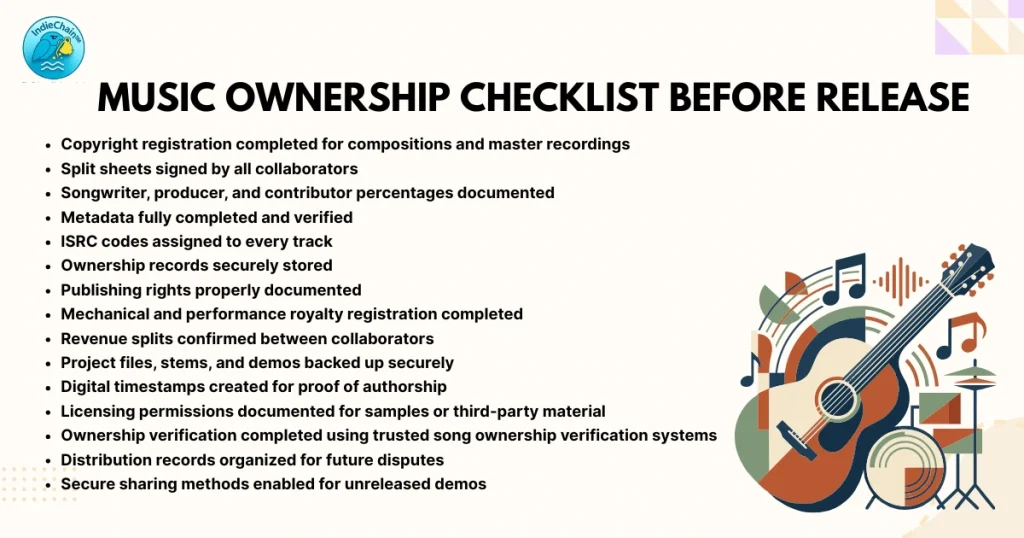
Before releasing music on Spotify, Apple Music, YouTube, or any other platform, independent artists should complete a full ownership protection review. Small details missed during the release process can later create serious legal, financial, or royalty-related problems.
Use this checklist to strengthen music ownership protection before launch:
- Copyright registration completed for compositions and master recordings
- Split sheets signed by all collaborators
- Songwriter, producer, and contributor percentages documented
- Metadata fully completed and verified
- ISRC codes assigned to every track
- Ownership records securely stored
- Publishing rights properly documented
- Mechanical and performance royalty registration completed
- Revenue splits confirmed between collaborators
- Project files, stems, and demos backed up securely
- Digital timestamps created for proof of authorship
- Licensing permissions documented for samples or third-party material
- Ownership verification completed using trusted song ownership verification systems
- Distribution records organized for future disputes
- Secure sharing methods enabled for unreleased demos
Modern tools available through a digtial music licensing platform can simplify ownership tracking, licensing management, and royalty documentation for independent creators managing multiple releases.
Artists who approach releases with organized ownership systems reduce the risk of disputes, missing royalties, and unauthorized claims. Proper preparation before launch creates stronger long-term protection for both music rights and future revenue streams.
Why Independent Artists Need Ownership Verification Platforms
The modern music industry has created more opportunities for independent artists than ever before. Musicians can now distribute songs globally without major labels, build audiences through social platforms, and monetize music directly through streaming services. However, this creator-driven economy has also introduced serious ownership challenges.
Music now moves across hundreds of digital platforms within seconds. Songs are streamed globally, sampled in short-form content, reposted across social media, and uploaded to multiple distribution channels simultaneously. Without transparent ownership records, artists may struggle to prove authorship, resolve disputes, or recover lost royalties.
This is why ownership verification platforms are becoming increasingly important for independent musicians.
A modern independent artist certification platform helps creators establish verified ownership records before release. These systems create organized documentation that can support copyright claims, licensing negotiations, and royalty disputes in the future.
Ownership verification platforms help artists:
- prove authorship with secure digital records
- track royalty ownership across releases
- manage licensing documentation
- strengthen credibility with labels and distributors
- create timestamped ownership verification
- reduce collaboration disputes
- maintain transparent ownership history
For independent creators handling collaborations remotely, digital ownership systems provide additional protection when working with producers, engineers, vocalists, or co-writers across different countries.
Many artists also use song ownership verification tools to establish proof of creation before publicly sharing demos or unreleased tracks. This becomes increasingly important as AI-generated content, fake uploads, and unauthorized reproductions continue growing across the music industry.
Ownership verification platforms are no longer just optional tools for major labels or large publishers. They are becoming essential infrastructure for independent artists who want long-term control over their music careers, royalties, and intellectual property.
Final Thoughts
Music is more than creative expression — it is intellectual property with long-term financial value. Every unreleased song, beat, lyric, or composition represents hours of creative work and future revenue potential. Yet many independent artists still focus entirely on promotion while overlooking ownership protection until problems appear.
In today’s digital music industry, ownership protection is no longer optional. AI-generated duplication, fake uploads, unauthorized sampling, royalty leakage, and collaboration disputes have made music security an essential part of every release strategy. Artists who fail to document ownership early often spend far more time and money trying to recover rights later.
Successful musicians now think beyond recording and distribution. They approach music like a business asset that requires legal, technical, and financial protection from the beginning.
Protecting your music before release helps:
- secure royalty earnings
- strengthen licensing opportunities
- prevent ownership disputes
- maintain control over masters
- establish professional credibility
As Music Marketing Strategies continue evolving, ownership verification and digital security will become even more important for independent creators navigating global distribution platforms.
Artists focused on Promoting Music Independently should combine audience growth with strong ownership management to build sustainable careers.
If you are serious about protecting your work, now is the time to verify ownership, organize your rights, secure your royalties, and use a trusted digtial music licensing platform before your next release goes live.