

Table of Contents
Introduction: The Metric That Misleads Most Artists
Streams, followers, and views look impressive on a dashboard. They rarely translate into a sustainable career.
Many independent artists discover this the hard way. A track crosses thousands of plays, yet live shows remain half-empty. Social profiles grow, but merch sales stay flat. The disconnect is not a lack of talent. It is a lack of a system.
To Build a Fanbase as an Independent Artist, you must shift from chasing visibility to building relationships. A fanbase is not an audience you perform for; it is a community that invests in you, returns to your work, and actively supports your growth. This article breaks down the system behind that transformation—what works, why it works, and how to implement it with precision.
What It Really Means to Build a Fanbase
An audience consumes. A fanbase participates. Superfans advocate.
That distinction is what separates short-term traction from long-term income. The Best Selling Music Artists did not become successful by maximizing reach alone. They built emotional equity with their listeners. Fans feel seen, represented, or understood through the artist’s work—and that emotional alignment drives loyalty.
To build a fanbase, you need to answer one question with clarity:
Why should someone care about you beyond a single song?
This answer shapes your content, your communication, and your long-term positioning.
The 4-Stage Fan Growth System
Every supporter moves through a predictable journey. Understanding and optimizing each stage is essential if you want consistent growth.
1. Discovery: Getting Found in a Crowded Market
Discovery is where attention begins, not where success is secured.
Your music can be discovered through:
- Short-form video platforms
- Streaming playlists
- Collaborations
- Live performances
- Word-of-mouth sharing
However, discovery without direction leads to drop-off. Most artists invest heavily here but fail to capture attention meaningfully.
To improve discovery:
- Focus on strong hooks within the first 5–10 seconds of content
- Build a recognizable identity (visual, sonic, or thematic)
- Target a niche rather than appealing to everyone
Visibility is a gateway, not a destination.
2. Engagement: Turning Listeners into Followers
A listener who enjoyed one track must be given a reason to stay.
Engagement is built through consistent, personality-driven content:
- Behind-the-scenes creation processes
- Personal stories behind songs
- Opinions, insights, and perspectives
- Interactive formats (Q&A, polls, comments)
Artists who successfully Promote Your Music Independently understand that music alone is not enough. People follow artists because they connect with the human behind the work.
Consistency matters, but not in volume alone. It is about maintaining a rhythm that keeps you present in your audience’s mind without becoming noise.
3. Conversion: Turning Attention into Income
Conversion is where many artists hesitate. Asking for support feels uncomfortable, but avoiding it limits growth.
Your fans are willing to support you when:
- The value is clear
- The process is simple
- The ask feels intentional, not forced
Revenue channels include:
- Ticket sales
- Merchandise
- Digital exclusives
- Membership platforms
- Direct fan contributions
The key is positioning. Instead of framing your offer as a request, present it as an opportunity for fans to deepen their connection with your work.
4. Retention: Creating Superfans
Retention is the most underestimated stage, yet it has the highest impact on long-term success.
Superfans:
- Attend multiple shows
- Purchase consistently
- Share your work organically
- Defend and advocate for your brand
Retention strategies include:
- Early access to releases
- Personalized interactions
- Exclusive content or communities
- Public recognition of loyal supporters
A retained fan becomes a multiplier. They bring others into your ecosystem without additional marketing cost.
The Psychology Behind Superfans
People do not follow artists for technical excellence alone. They follow because of identity and emotion.
A fan connects with an artist when:
- The music reflects their personal experiences
- The artist represents something they value
- The community around the artist feels like belonging
This is where Music Marketing becomes more than promotion. It becomes storytelling. You are not just distributing content; you are shaping perception.
Understanding this psychological layer allows you to:
- Create more resonant content
- Communicate with clarity
- Build deeper, longer-lasting relationships
The Fanbase Flywheel: A System That Sustains Growth
A fanbase does not grow through isolated actions. It grows through a system where three components reinforce each other.
1. Creation (Production)
This includes your music, videos, and all creative outputs. Without consistent creation, there is nothing to build upon.
2. Distribution (Marketing)
This is how your work reaches new audiences. It includes platform strategy, collaborations, and content distribution.
3. Relationship Building (Engagement)
This is how you maintain and deepen the connection with your audience over time.
When these three elements operate together, they create momentum. If one is missing, growth slows or stops entirely.
Step-by-Step Blueprint to Build a Fanbase as an Independent Artist
Step 1: Define Your Fan Avatar
Instead of targeting “everyone,” define a specific listener:
- Age group
- Interests
- Preferred platforms
- Emotional triggers
- Listening habits
This clarity improves both content and targeting.
Step 2: Build a Content System
Replace random posting with a structured approach:
- 2–3 short-form videos per week
- 1 deeper storytelling piece (video or post)
- Daily interaction with comments and messages
Consistency builds familiarity. Familiarity builds trust.
Step 3: Create a Fan Funnel
Your growth should follow a path:
- Discovery content attracts attention
- Engagement content builds connection
- Conversion content drives action
- Retention efforts build loyalty
Each piece of content should serve a purpose within this flow.
Step 4: Monetize with Clarity
Define clear offers:
- Limited edition releases
- Exclusive experiences
- Premium content access
Make it easy for fans to understand how they can support you and what they receive in return.
Tools and Systems That Support Growth
Scaling your fanbase requires infrastructure:
- Streaming analytics tools to track listener behavior
- Social media insights to refine content
- Email or community platforms to maintain direct contact
Additionally, systems like a Music Rights Management System ensure that your work is protected and monetized properly, especially as your reach expands.
Common Mistakes That Limit Artist Growth
- Focusing only on virality instead of consistency
- Ignoring engagement after gaining attention
- Avoiding monetization due to fear of perception
- Posting without a clear strategy
- Failing to build direct relationships with fans
Each of these slows down the transition from audience to fanbase.
Case Study: From Passive Listeners to Paying Fans
Consider an independent artist who shifted from random content posting to a structured system:
- Defined a niche audience
- Built a consistent content schedule
- Introduced exclusive releases for loyal followers
Within months:
- Engagement rates increased significantly
- Show attendance improved
- Direct fan revenue became predictable
The change was not due to a viral moment. It was the result of a repeatable system.
Advanced Strategies Used by Successful Independent Artists
- Building email lists to reduce reliance on algorithms
- Creating private communities for deeper interaction
- Collaborating with artists who share overlapping audiences
- Offering limited-access content to increase perceived value
These strategies prioritize depth over reach.
Fanbase vs Followers: What Actually Matters
The 80/20 principle applies strongly here:
- A small percentage of fans generate most of your income
Metrics that matter:
- Engagement rate
- Conversion rate
- Retention rate
Follower count alone is not a reliable indicator of success.
30-Day Action Plan to Build a Fanbase as an Independent Artist (Expanded)
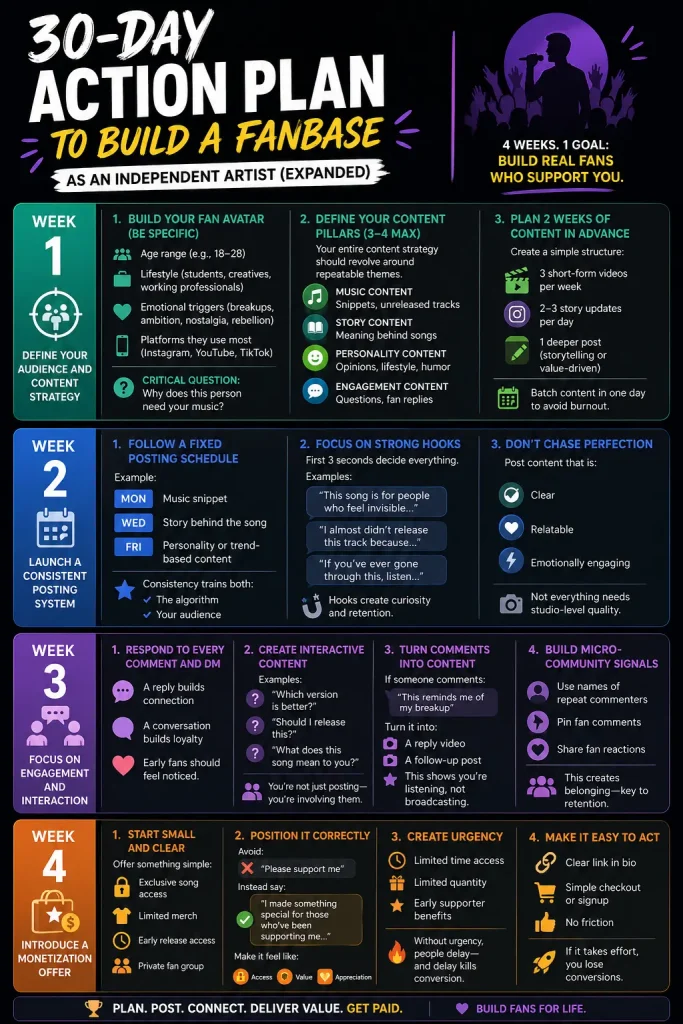
Week 1: Define Your Audience and Content Strategy
Most artists skip this and start posting blindly. That’s why their content doesn’t convert.
1. Build Your Fan Avatar (Be Specific)
Don’t say “people who like music.” Define:
- Age range (e.g., 18–28)
- Lifestyle (students, creatives, working professionals)
- Emotional triggers (breakups, ambition, nostalgia, rebellion)
- Platforms they use most (Instagram, YouTube, TikTok)
Critical question:
Why does this person need your music?
If you can’t answer this clearly, your content will feel generic.
2. Define Your Content Pillars (3–4 Max)
Your entire content strategy should revolve around repeatable themes:
Example:
- Music Content – snippets, unreleased tracks
- Story Content – meaning behind songs
- Personality Content – opinions, lifestyle, humor
- Engagement Content – questions, fan replies
This ensures consistency without confusion.
3. Plan 2 Weeks of Content in Advance
Create a simple structure:
- 3 short-form videos per week
- 2–3 story updates per day
- 1 deeper post (storytelling or value-driven)
Batch content in one day to avoid burnout.
Week 2: Launch a Consistent Posting System
This is where most artists fail—not because they lack ideas, but because they lack discipline.
1. Follow a Fixed Posting Schedule
Example:
- Monday: Music snippet
- Wednesday: Story behind the song
- Friday: Personality or trend-based content
Consistency trains both:
- The algorithm
- Your audience
2. Focus on Strong Hooks
First 3 seconds decide everything.
Examples:
- “This song is for people who feel invisible…”
- “I almost didn’t release this track because…”
- “If you’ve ever gone through this, listen…”
Hooks create curiosity and retention.
3. Don’t Chase Perfection
Post content that is:
- Clear
- Relatable
- Emotionally engaging
Not everything needs studio-level quality.
Week 3: Focus on Engagement and Interaction
This is where listeners turn into actual fans.
Most artists post and disappear. That kills momentum.
1. Respond to Every Comment and DM
- A reply builds connection
- A conversation builds loyalty
Early fans should feel noticed.
2. Create Interactive Content
Examples:
- “Which version is better?”
- “Should I release this?”
- “What does this song mean to you?”
You’re not just posting—you’re involving them.
3. Turn Comments into Content
If someone comments:
“This reminds me of my breakup”
Turn it into:
- A reply video
- A follow-up post
This shows you’re listening, not broadcasting.
4. Build Micro-Community Signals
- Use names of repeat commenters
- Pin fan comments
- Share fan reactions
This creates belonging—key to retention.
Week 4: Introduce a Monetization Offer
Now you have:
- Attention (Week 2)
- Connection (Week 3)
It’s time to convert.
1. Start Small and Clear
Don’t overcomplicate. Offer something simple:
- Exclusive song access
- Limited merch
- Early release access
- Private fan group
2. Position It Correctly
Avoid:
“Please support me”
Instead say:
“I made something special for those who’ve been supporting me…”
Make it feel like:
- Access
- Value
- Appreciation
3. Create Urgency
- Limited time access
- Limited quantity
- Early supporter benefits
Without urgency, people delay—and delay kills conversion.
4. Make It Easy to Act
- Clear link in bio
- Simple checkout or signup
- No friction
If it takes effort, you lose conversions.
What Happens After 30 Days?
If executed properly, you will have:
- A defined audience
- A consistent content engine
- Initial fan relationships
- Your first conversion signals
This is where most artists see a shift:
- Engagement becomes predictable
- Fans start recognizing you
- Revenue becomes possible
The Real Insight Most Artists Miss
This plan is not about 30 days.
It’s about building a system you repeat every month with improvements:
- Better content
- Stronger engagement
- Smarter offers
That’s how you Build a Fanbase as an Independent Artist—not through one viral moment, but through consistent, structured execution.
Conclusion: Build Systems, Not Just Visibility
To Build a Fanbase as an Independent Artist, you must think beyond exposure. Visibility may bring attention, but only systems create sustainability.
A real fanbase is built through:
- Consistent value
- Clear communication
- Intentional relationships
The artists who succeed long-term are not those who chase numbers. They are the ones who build connections that last.
If you approach your career with this mindset, growth stops being unpredictable and starts becoming measurable, repeatable, and scalable.Introduction: The Metric That Misleads Most Artists
Streams, followers, and views look impressive on a dashboard. They rarely translate into a sustainable career.
Many independent artists discover this the hard way. A track crosses thousands of plays, yet live shows remain half-empty. Social profiles grow, but merch sales stay flat. The disconnect is not a lack of talent. It is a lack of a system.
To Build a Fanbase as an Independent Artist, you must shift from chasing visibility to building relationships. A fanbase is not an audience you perform for; it is a community that invests in you, returns to your work, and actively supports your growth. This article breaks down the system behind that transformation—what works, why it works, and how to implement it with precision.
FAQs
What is the difference between a fanbase and followers for an independent artist?
Followers are passive metrics that reflect visibility, while a fanbase represents an active community that engages, supports, and invests in your work consistently over time.
How long does it take to build a loyal fanbase as an independent artist?
Building a true fanbase is a gradual process that depends on consistency, clarity of positioning, and engagement strategy, typically taking months to years rather than days or weeks.
Do independent artists need to be active on every platform to grow their fanbase?
No, focusing on a few platforms where your target audience is most active is far more effective than spreading efforts too thin across multiple channels.
How can an independent artist start monetizing their fanbase without losing trust?
Monetization works best when offers feel valuable and aligned with the audience, such as exclusive content, experiences, or merchandise that deepen the connection rather than interrupt it.
Why do many artists struggle to convert listeners into paying fans?
Most artists focus heavily on discovery but lack a structured system for engagement, conversion, and retention, which leads to high drop-off after initial exposure.