
Independent Dance Artists: Avoid Failure and Win With the Complete Regional Expansion Playbook for 2026 (Step-by-Step Guide)
Introduction: Why Independent Dance Artists Fail Without Regional Expansion in 2026
Independent dance artists in 2026 are no longer limited by access to distribution, production tools, or global platforms. Anyone can upload music worldwide in minutes. Yet despite this unprecedented access, only a small percentage of independent dance artists achieve sustained, scalable growth.
The difference is not talent.
It is not genre.
It is not consistency alone.
The difference is structured expansion.
Most independent dance artists fall into one of two traps:
- They stay locked inside a single local pocket, hoping visibility will magically spread
- Or they jump randomly from city to city, chasing momentum without a system
Both approaches fail long-term.
The independent dance artists who win treat geography as a repeatable system, not a gamble.
This guide is the fourth pillar in the IndieChain™ independent dance artist education series. It builds directly on:
- How to Release an Independent Dance Track in 2026 Without a Major Label
https://blogs.indiechain.io/release-an-independent-dance-track/ - Common Mistakes Independent Dance Artists Make in 2026
https://blogs.indiechain.io/independent-dance-artists-mistakes-2026/ - How Independent Dance Artists Build a Brand and Fanbase in 2026
https://blogs.indiechain.io/independent-dance-artists-brand-fanbase-2026/
If Blog 1 showed how to release, Blog 2 showed what to avoid, and Blog 3 showed how to build brand and fanbase, this article explains how independent dance artists expand regionally without losing momentum, money, or identity.
Step 1: Why Independent Dance Artists Must Think in Regions, Not Cities
Cities do not grow careers.
Regions do.
Independent dance artists often treat each city as an isolated win. In reality, sustainable growth happens when cities are connected into regional corridors that reinforce each other.
A region creates:
- Repetition in listener behavior
- Playlist crossover and algorithm reinforcement
- Touring efficiency
- Brand familiarity across markets
Examples of Regional Corridors
- Columbia → Charleston → Charlotte → Atlanta
- Chicago → Milwaukee → Madison → Minneapolis
- Los Angeles → San Diego → Phoenix → Las Vegas
Independent dance artists who dominate one city and then expand outward logically scale faster than artists who scatter attention across unrelated markets.
Step 2: The Regional Expansion Mindset (Where Independent Dance Artists Go Wrong)
Most independent dance artists expand too early or too chaotically.
Common mistakes include:
- Expanding before fully understanding one release city
- Booking shows in cities with no supporting streaming data
- Running ads everywhere instead of where listeners already exist
- Treating expansion as marketing instead of infrastructure
Regional expansion is not exposure.
It is controlled duplication.
If you cannot clearly explain why you are entering a new city, you are not ready to expand.
Step 3: The Release City → Regional Hub → Corridor Model
The most effective expansion model for independent dance artists is:
Release City → Regional Hub → Corridor Expansion
Release City
The first city where:
- Early engagement is strongest
- Fans save and replay the track
- Content performs above baseline
- DJs or venues respond organically
Regional Hub
A larger city that:
- Influences surrounding markets
- Shapes nightlife and playlist culture
- Acts as a multiplier
Corridor Expansion
Secondary cities that:
- Share audience taste
- Are geographically reachable
- Respond similarly to your sound
This model keeps growth measurable, repeatable, and scalable.
Step 4: Using Streaming Data to Identify Expansion Cities
Independent dance artists should never expand blindly.
Use:
- Spotify for Artists → https://artists.spotify.com
- Apple Music for Artists → https://artists.apple.com
Key Metrics to Track
- Listener growth by city
- Save-to-stream ratio
- Repeat listener percentage
- Playlist additions
- Post-release retention
When a city outside your release market shows above-average engagement, it becomes a candidate for expansion.
Expansion should follow data, not ego.
Step 5: How Independent Dance Artists Validate a City Before Spending Money
Before booking shows, running ads, or traveling, independent dance artists must validate digitally.
City Validation Checklist
- Appears in top 10–15 listener locations
- Engagement metrics exceed baseline
- Organic comments or shares originate from that city
- DJs or promoters respond to outreach
If a city cannot pass digital validation, it will not convert offline.
Step 6: Regional Advertising Without Burning Your Budget
Paid ads work after organic signals appear, not before.
Independent dance artists should:
- Run short, geo-targeted campaigns
- Focus on one city at a time
- Reuse the same creative for recognition
- Measure saves and follows, not clicks
Regional advertising reinforces demand — it does not create it.
Step 7: DJ, Playlist, and Venue Layering by Region
Expansion accelerates when digital and physical signals align.
Independent dance artists should layer:
- Streaming growth
- DJ support
- Playlist traction
- Live performance feedback
Priority Targets
- Dance-friendly DJs
- Curated regional playlists
- Venues aligned with your sound
- College and nightlife ecosystems
Each layer strengthens algorithm confidence.
Step 8: Touring as a Regional Tool, Not a Flex
Touring should follow validated regions, not ambition.
A smart regional tour:
- Minimizes travel distance
- Maximizes repeat exposure
- Generates content across cities
- Reinforces brand memory
Independent dance artists who tour regionally build stronger fan retention than artists who appear once and disappear.
Step 9: Content Strategy During Regional Expansion
Expansion without content is invisible.
Independent dance artists should create:
- City-specific shoutouts
- Behind-the-scenes travel clips
- Crowd reaction videos
- “First time in [City]” moments
- Regional dance challenges
This content feels intentional, not generic.
Step 10: Maintaining Brand Consistency While Expanding
Expansion must never dilute identity.
Independent dance artists must maintain:
- Consistent visuals
- Stable messaging
- Recognizable sound
- Clear values
Consistency builds trust.
Trust builds repeat listeners.
Step 11: Scaling One Release Across Multiple Regions
Independent dance artists often rush to release new music too quickly.
One strong track can support:
- Initial release city
- Multiple regional expansions
- Several performance cycles
- Months of content
Regional expansion extends release lifespan and increases catalog value.
Step 12: Case AlignStep 12: Case Study Follow-Up — Don Williano, “Boogie Slide,” and the IndieChain™ Expansion Framework
To understand how regional expansion works in practice, independent dance artists need more than theory. They need a real release, real data, and real systems applied step by step.
That is exactly why Don Williano’s “Boogie Slide” is being used as a live case study inside the IndieChain™ ecosystem.
“Boogie Slide” is not presented as a viral anomaly or a one-off success story. It is being tracked intentionally as an example of how independent dance artists can release, expand, protect, and scale a single record over time using structured infrastructure.
Why “Boogie Slide” Matters for Independent Dance Artists
For many independent dance artists, the mistake is assuming that success comes from chasing virality. “Boogie Slide” demonstrates the opposite approach:
- Controlled release
- Regional momentum before national push
- Data-validated expansion
- Infrastructure layered after traction appears
This mirrors how professional catalogs are built — not how hype cycles burn out.
Step 12: “Boogie Slide” as a Phase-2 IndieChain™ Case Study (Distribution, Fingerprinting, Analytics)
As IndieChain™ activates advanced modules, “Boogie Slide” transitions from a standard release into a fully instrumented digital asset.
This phase focuses on visibility, protection, and intelligence, not just streams.
White-Label Distribution via SonoSuite (IndieChain™ Powered)
Through IndieChain™’s white-label distribution layer powered by SonoSuite, “Boogie Slide” operates under a professional release pipeline while maintaining full independence.
This means:
- IndieChain™ remains the artist-facing platform
- SonoSuite handles DSP delivery, reporting, and compliance
- No fragmented logins or disconnected tools
- One unified dashboard for performance visibility
For independent dance artists, this solves a major problem: scaling without operational chaos.
Audio Fingerprinting and Derivative Detection with ACRCloud
Once fingerprinting is enabled, “Boogie Slide” becomes more than a streaming track — it becomes a tracked audio identity.
Using ACRCloud, IndieChain™ enables:
- Audio fingerprint creation for “Boogie Slide”
- Detection across platforms and formats
- Identification of unauthorized uploads or reposts
- Monitoring of derivative uses (edits, remixes, short-form video)
- Visibility into where the music travels beyond DSPs
For independent dance artists, this is critical. Instead of guessing how music spreads, artists gain verifiable usage intelligence.
This supports:
- Rights protection
- Licensing readiness
- Sync opportunities
- Evidence for takedowns or disputes
Regional Performance Intelligence with SpotOnTrack
Streaming totals alone do not explain where momentum is forming.
With SpotOnTrack integration, IndieChain™ tracks how “Boogie Slide” performs at a regional and playlist level, including:
- City-by-city engagement trends
- Playlist velocity and adds
- Momentum signals across regions
- Comparative performance against similar releases
This allows independent dance artists to answer real growth questions:
- Which regions are responding organically?
- Where should touring or promotion activate next?
- Which cities justify deeper investment?
Expansion becomes precision-based, not speculative.
How the IndieChain™ Stack Works Together for “Boogie Slide”
Once all Phase-2 features are active, the lifecycle for “Boogie Slide” looks like this:
- SonoSuite distributes the track via IndieChain™ white label
- ACRCloud fingerprints and monitors usage and derivatives
- SpotOnTrack tracks playlists, regions, and momentum
- IndieChain™ dashboards unify all performance intelligence
- Don Williano makes decisions based on verified data, not assumptions
This is the same operational visibility major labels use — with one key difference:
👉 The independent dance artist retains ownership, control, and transparency.
What Independent Dance Artists Should Learn from the “Boogie Slide” Case Study
The lesson is not about one song.
It is about mindset and systems.
Independent dance artists who scale in 2026:
- Treat releases as long-term assets
- Expand regionally before chasing national exposure
- Use data to guide movement
- Protect catalog value early
- Build infrastructure after traction, not before
“Boogie Slide” is intentionally positioned as an ongoing reference release, allowing artists to see:
- How regional expansion unfolds over time
- The difference between surface metrics and deep analytics
- How fingerprinting protects long-term value
- How data informs smarter touring and promotion
Looking Ahead: From Case Study to Operating Standard
As IndieChain™ continues activating certification, analytics, and enforcement layers, releases like “Boogie Slide” become the blueprint, not the exception.
The goal is not to spotlight one artist.
The goal is to show independent dance artists how careers are built when systems replace guesswork.
“Boogie Slide” is the starting point — not the finish line.
Step 13: Case Study Continuation — “Boogie Slide” + IndieChain™ Phase 2 Stack
As independent dance artists scale, infrastructure matters as much as creativity.
Boogie Slide is positioned as a forward-looking case study inside IndieChain™ Phase 2, which activates:
- White-label distribution
- Audio fingerprinting
- Territory analytics
- Usage monitoring and enforcement
Why Infrastructure Matters After Release
Most independent dance artists stop at “getting the song on DSPs.”
That’s where leverage disappears.
Professional growth requires:
- Usage verification
- Derivative detection
- Territory intelligence
- Real-time analytics
White-Label Distribution via SonoSuite
With IndieChain™ + SonoSuite:
- IndieChain™ remains the artist-facing brand
- Enterprise infrastructure handles delivery and compliance
- Artists operate from one unified dashboard
This allows independent dance artists to scale without fragmentation.
Audio Fingerprinting With ACRCloud
Once fingerprinted, Boogie Slide becomes a tracked digital asset.
ACRCloud enables:
- Fingerprint creation
- Detection across platforms
- Unauthorized upload monitoring
- Derivative use identification
- Short-form video tracking
This supports:
- Rights enforcement
- Licensing readiness
- Royalty dispute clarity
Advanced Analytics With SpotOnTrack
SpotOnTrack adds:
- Playlist-level analytics
- City-by-city momentum tracking
- Comparative performance data
- Touring and promo indicators
Independent dance artists can answer:
- Which cities drive real engagement?
- Where should budget concentrate?
- When is live activation justified?
End-to-End Flow
- SonoSuite distributes via IndieChain™
- ACRCloud fingerprints and monitors usage
- SpotOnTrack tracks performance and regions
- IndieChain™ dashboards unify intelligence
- Artists act on verified data
This mirrors major-label operations — without surrendering ownership.
Step 14: When Independent Dance Artists Should Expand Nationally
National expansion should happen only when:
- Multiple regions show traction
- Engagement remains strong across cities
- Content performs without heavy ad spend
- Brand recall is visible
National expansion amplifies strength — or exposes weakness.
Step 15: Regional Expansion as an SEO and Discoverability Strategy
From an SEO perspective, regional specificity:
- Builds topical depth
- Strengthens semantic authority
- Expands long-tail relevance
- Improves internal linking structure
Search engines reward real-world execution, not abstract theory.
Step 16: The Regional Expansion Checklist for Independent Dance Artists
Before expanding, confirm:
- One city is fully validated
- Data supports expansion
- Budget is controlled
- Content plan exists
- Brand identity is locked
- Follow-up cities are mapped
Expansion without a checklist is guesswork.
Step 17: The Regional Expansion Budget Framework (So Independent Dance Artists Don’t Go Broke)
Most independent dance artists don’t fail because they “didn’t work hard.” They fail because expansion becomes a spending spree with no operating rules.
Regional growth should be funded like a campaign, not a lifestyle. You are buying data and repeat exposure — not validation.
The 70/20/10 Rule (Simple and Effective)
- 70% = proven city/region (where the track already shows engagement)
- 20% = adjacent corridor cities (closest match by taste + distance)
- 10% = experimental testing (new market hypotheses)
This keeps independent dance artists from dumping money into cities that have not earned investment.
Expansion KPIs That Matter (Ignore Vanity Metrics)
- Save rate (saves per listener)
- Follower conversion (new followers per 1,000 listeners)
- Repeat listening (returning listeners after 7–14 days)
- Playlist velocity (adds + position improvement over time)
- DM-to-action rate (DJ/promoter replies that lead to real placements)
If a region improves these KPIs, it is working. If it only improves views, it is entertainment — not growth.
Step 18: The Regional Partner Flywheel (Dancers → DJs → Hosts → Venues)
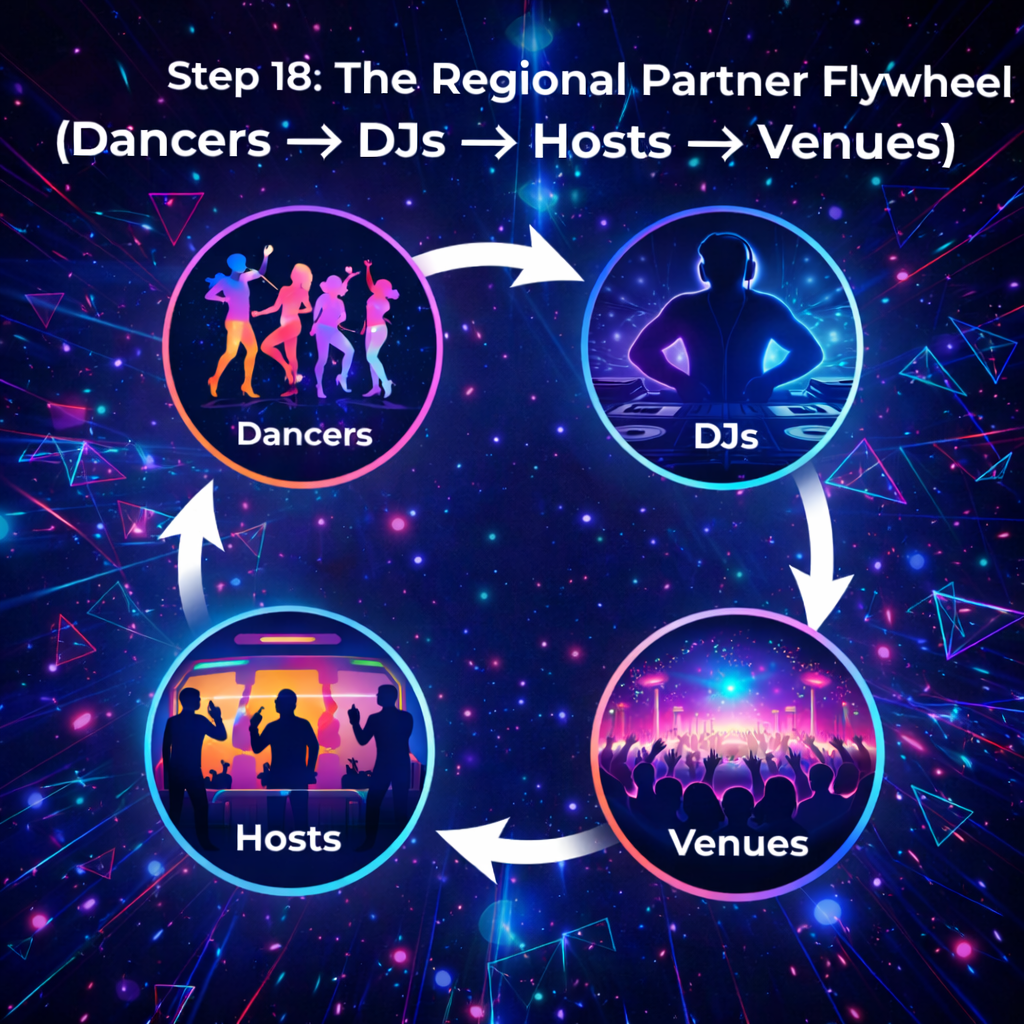
Regional partner flywheel showing how independent dance artists grow through dancers, DJs, hosts, and venues working together
Independent dance artists expand faster when they stop trying to “do it alone” in every city. Your goal is to plug into a local ecosystem that already has attention.
The simplest regional flywheel looks like this:
- Dance leaders (line-dance captains, instructors, popular creators)
- Regional DJs (club DJs + mixshow DJs + event DJs)
- Event hosts/promoters (they control rooms and calendars)
- Venues (where repeat exposure becomes culture)
Each layer multiplies the others. When independent dance artists build this chain in one city, the corridor becomes easier.
What to Offer Partners (So They Say Yes)
- Clean DJ pack (radio edit + intro/outro + BPM + key + hook timestamps)
- Dance demo video (15–30 seconds, vertical + clean audio)
- Shoutout assets (city name overlays, flyer template, IG story template)
- Simple partnership ask (“2 plays this weekend + 1 story tag + 1 crowd clip”)
- Proof of traction (screenshots of saves, growth, comments from that region)
Independent dance artists who show clarity get faster buy-in than artists who send generic “check my song” messages.
Step 19: The 30–60–90 Regional Expansion Sprint (Copy/Paste Blueprint)
Regional expansion works best when it is time-boxed and measured. Here is a simple sprint structure.
Days 1–30: Signal Capture (Prove the City)
Objective: Confirm the city is real before you travel or overspend.
- Post 3 city-specific pieces of content (shoutout + clip + dance moment)
- Run a micro ad test (geo-targeted, short, same creative for recognition)
- Outreach to 10 DJs and 10 dancers/creators in that city
- Track: saves, follows, comments, DMs, playlist adds
Pass = engagement is above baseline and at least a few people respond without heavy pushing.
Days 31–60: Activation (Turn Attention Into Repeat Exposure)
Objective: Create repeat touchpoints so people remember you.
- Secure 1–2 DJ plays or event spins
- Get 2 creator clips using the same hook
- Post weekly: “City check-in” + “behind the scenes”
- Offer a giveaway or meet-up incentive (cheap but effective)
Pass = repeat listening rises and people begin tagging you without being asked.
Days 61–90: Conversion (Make the City a True Node)
Objective: Turn the city into a hub you can return to.
- Book a small live activation (open mic, dance night, club set, pop-up)
- Capture crowd reaction footage (this becomes your next ad creative)
- Build a city contact list (DJs, dancers, hosts, venues)
- Identify the next 2 corridor cities and repeat the cycle
Pass = the city produces ongoing streams and content even when you stop spending.
Step 20: The “One City Per Cycle” Rule (How Independent Dance Artists Scale Without Losing Focus)
Most independent dance artists kill momentum by trying to expand everywhere at once.
A simple rule:
One primary city per 30–60–90 cycle.
Everything else is support.
Why This Works
- Your content becomes consistent instead of scattered
- Algorithms get clearer signals
- Partnerships deepen faster
- You build a repeatable expansion machine
If you are in three cities at once, you’re usually in none.
Step 21: Regional Expansion → National Expansion (The Trigger Rules)
National expansion should happen only when:
- 2–3 regions show real traction at the same time
- Your engagement stays high without constant ads
- You have repeat partners (DJs/creators) in multiple cities
- Your content performs with momentum, not just spikes
- You can travel/activate without going into debt
National expansion amplifies strength — or exposes weakness.
Step 22: Mistake-Proof Expansion Rules (Non-Negotiables)
Independent dance artists who win follow rules like policy.
- Don’t book shows in a city that fails digital validation
- Don’t run wide ads without proven engagement signals
- Don’t travel just to “post a picture”
- Don’t abandon your release city while chasing new ones
- Don’t change your sound/brand to fit every market
- Don’t “start over” every city — duplicate what already works
Expansion is controlled duplication, not constant reinvention.
Step 23: The IndieChain™ Regional Expansion Operating Standard (How to Make This Repeatable)
IndieChain™ treats regional expansion like an operating system:
- Distribution visibility (SonoSuite layer)
- Fingerprint + usage intelligence (ACRCloud layer)
- Playlist + territory analytics (SpotOnTrack layer)
- Unified dashboards to see what regions are truly building momentum
When independent dance artists can see where growth is forming, they stop guessing and start investing with precision.
This is the key shift:
From “promotion” to “infrastructure-driven expansion.”
Step 24: Final Thoughts — Expansion Is a System, Not a Gamble
Independent dance artists who win in 2026 do not rely on luck. They:
- Release strategically
- Build brand intentionally
- Expand regionally
- Track data obsessively
- Repeat what works
Regional dominance precedes national visibility.
If you can win one city, then one region, you can build a sustainable independent career without sacrificing ownership, identity, or control.
Short Conclusion CTA (Soft, Non-Salesy IndieChain™ Mention)
Independent dance artists don’t fail because they lack talent — they fail because growth is left to chance.
Regional expansion replaces guessing with structure. It allows independent dance artists to build momentum methodically, protect their catalog, and extend the life of each release without burning money or identity.
IndieChain™ exists to support this type of growth — not by promising shortcuts, but by giving independent dance artists the visibility, data, and infrastructure needed to make informed decisions as careers scale.
Whether you use IndieChain™ now or later, the principle remains the same: systems outperform hope.
Regional Outreach DM Templates (Copy & Paste)
DJ Outreach DM Template
What’s good [DJ Name], hope all is well.
I’m an independent dance artist and I’m seeing organic traction for my record in [City] — saves, repeat plays, and local engagement.
I’ve heard your sets and feel the energy aligns. If you’re open, I’d love to send a clean DJ pack for feedback. No pressure at all — just respect your ear and your floor.
Dancer / Creator Outreach DM Template
Hey [Name], quick message.
I’m an independent dance artist and my track is gaining momentum in [City]. I’m spotlighting dancers who naturally fit the vibe — no scripts, no forced trends.
If you’re down to move to it your way, I’d love to repost and credit you. Either way, respect your work.
Venue / Promoter Outreach DM (Optional Add-On)
Hi [Name], appreciate your time.
I’m an independent dance artist building regional momentum and I’m seeing real engagement in [City] — streams, saves, and DJ support.
I’m planning small, high-energy activations rather than one-off appearances. If there’s an opportunity that aligns, I’d love to connect and explore it.
Final Thoughts: Expansion Is a System, Not a Gamble
Independent dance artists who win in 2026 do not rely on luck.
They:
- Release strategically
- Build brand intentionally
- Expand regionally
- Track data obsessively
- Repeat what works
Regional dominance precedes national visibility.
If you can win one city, then one region, you can build a sustainable independent career without sacrificing ownership, identity, or control.
Related Reading (Internal Links)
- https://blogs.indiechain.io/release-an-independent-dance-track/
- https://blogs.indiechain.io/independent-dance-artists-mistakes-2026/
- https://blogs.indiechain.io/independent-dance-artists-brand-fanbase-2026/

FAQ Schema (Rank Math-Ready)
Q: What is white-label distribution for independent dance artists?
A: It allows artists to distribute through enterprise infrastructure while maintaining their own brand and dashboard.
Q: How does IndieChain™ use SonoSuite?
A: SonoSuite powers DSP delivery and compliance while IndieChain™ controls the artist experience.
Q: Why is audio fingerprinting important in 2026?
A: It enables usage tracking, derivative detection, and rights protection across platforms.
Q: How does SpotOnTrack help expansion decisions?
A: It identifies which regions and playlists drive real momentum.
Q: How long should independent dance artists stay in one region before expanding?
A: Until engagement stabilizes — repeat listeners, saves, and organic content from that region should remain consistent without constant ad spend.
Q: Do independent dance artists need a large budget for regional expansion?
A: No. Regional expansion prioritizes precision over scale. Small, targeted spend outperforms wide, unfocused campaigns.
Q: Can independent dance artists expand regionally without touring?
A: Yes. Digital validation should always come first. Touring should reinforce existing demand, not attempt to create it.
Q: What’s the biggest regional expansion mistake independent dance artists make?
A: Entering cities based on ego, exposure, or invitations without supporting data.
Q: How many regions should independent dance artists focus on at once?
A: One primary region per expansion cycle. Multiple regions should only be pursued once systems and signals are proven.
Q: Is regional expansion more effective than national marketing?
A: Yes. Regional dominance creates algorithm confidence and fan loyalty, which makes national expansion more efficient later.
Q: How does regional expansion protect long-term catalog value?
A: It extends release lifespan, increases repeat listening, and builds usage data that supports licensing, touring, and future monetization.