
Independent Dance Artists: Avoid Failure With the Ultimate Brand and Fanbase Guide in 2026
Introduction: Why Independent Dance Artists Must Think Beyond Music in 2026
In 2026, independent dance artists are no longer competing only on sound quality. Production standards are higher than ever, access to global distribution is fully democratized, and thousands of new dance tracks are uploaded to DSPs every single day. Talent alone is no longer the bottleneck.
The real differentiator is brand clarity, fan connection, and systemized growth.
Independent dance artists who treat their careers like scalable businesses consistently outperform those who approach releases as isolated creative moments. They build repeat listenership, predictable income, and long-term catalog value. More importantly, they own their audience instead of renting attention from platforms they do not control.
This article is a pillar guide for independent dance artists who want sustainable growth without major-label dependency. It builds on:
- Blog 1: How to Release an Independent Dance Track in 2026 Without a Major Label
- Blog 2: Common Mistakes Independent Dance Artists Make in 2026
If Blog 1 explained how to release, and Blog 2 explained what to avoid, this guide explains how to build a real brand and fanbase that compounds over time.
Step 1: Define a Clear Brand Identity Before You Release Music
Most independent dance artists begin by releasing music and hoping an identity forms organically. This approach leads to inconsistent messaging, weak audience recall, and poor long-term retention.
A brand is not a logo, a font, or a color palette. A brand is the expectation you set and consistently deliver.
Critical Questions Every Independent Dance Artist Must Answer
- What emotional state does my music create?
- Where does my sound live? (club, festival, underground, lounge, cinematic)
- Who is my ideal listener?
- Why should someone follow me instead of another artist in the same genre?
Without clear answers, marketing becomes expensive and ineffective.
The Four Brand Pillars
Every successful independent dance artist aligns these pillars:
- Sound Identity – BPM range, groove style, genre clarity, influences
- Visual Identity – cover art consistency, typography, color systems, imagery
- Cultural Positioning – underground vs mainstream, niche vs global
- Value Proposition – what fans gain by staying connected
When these pillars are aligned, every release reinforces brand memory.
Step 2: Build Owned Platforms Instead of Relying on Algorithms
Social platforms are necessary but unstable. Algorithms change. Reach fluctuates. Accounts can be restricted or removed without explanation.
Independent dance artists who scale in 2026 prioritize owned infrastructure.
Minimum Owned Stack for Independent Dance Artists
- Artist website (your central hub)
- Email subscriber list
- Optional SMS notifications
- Release landing pages
- Analytics dashboard
Your website should act as the permanent home for your brand, releases, and audience data. Social platforms should funnel traffic back to assets you control, not trap fans inside third-party ecosystems.
Step 3: Turn Every Release Into a 30–60 Day Content Engine
One of the most common mistakes highlighted in Blog 2 is treating releases as one-day events. Professional independent dance artists treat releases as campaigns.
Content Assets to Create Per Release
For every single or EP, plan:
- Short-form teaser clips (15–30 seconds)
- Studio or creation footage
- Visualizers and loop videos
- Rehearsal or performance clips
- Fan reaction reposts
- Educational breakdowns of the track
A single release should generate weeks of consistent content across Instagram, TikTok, YouTube Shorts, and Reels. The goal is not virality, but recognition and repetition.
Step 4: Convert Listeners Into a Community
Streams are passive. Communities are active.
Independent dance artists must move fans through a lifecycle:
Listener → Follower → Subscriber → Supporter → Advocate
Community-Building Strategies That Work
- Early-access drops
- Private listening links
- Exclusive edits or versions
- Behind-the-scenes updates
- Digital collectibles or certifications
When fans feel included, retention and lifetime value increase dramatically.
Step 5: Monetize Without Undermining Your Brand
Monetization in 2026 is layered, intentional, and brand-aligned.
Sustainable Monetization Channels for Independent Dance Artists
- Streaming royalties
- Live performance fees
- Merchandise (physical and digital)
- Fan memberships
- Sync and licensing opportunities
- Digital certifications and collectibles
The right monetization strategy strengthens trust instead of damaging it.
Step 6: Track Metrics That Actually Matter
Follower counts are vanity metrics. Data-driven independent dance artists track:
- Listener retention
- Save-to-stream ratios
- Playlist adds
- Email open and click rates
- Geographic performance
- Repeat engagement
Independent dance artists should regularly review audience data using:
These tools reveal where your listeners live, how they behave, and which cities are turning casual listeners into repeat fans.
Step 7: Think in Catalogs, Not Singles
Independent dance artists who win long-term think in catalogs. Each release should:
- Reinforce brand identity
- Expand audience reach
- Increase long-term catalog value
Momentum compounds when releases are aligned strategically instead of randomly.
Step 8: Building Long-Term Fan Relationships (Retention Over Reach)
Many independent dance artists focus heavily on reach—more streams, more followers, more impressions. While reach matters, retention is where real careers are built.
Retention means fans return, engage, purchase, and advocate. A smaller but loyal fanbase consistently outperforms a large but disengaged audience.
Retention Systems Independent Dance Artists Should Build
- Email sequences for new subscribers
- Fan-only announcements and drops
- Early access to unreleased material
- Personalized messaging during launches
- Consistent communication cadence (not spam)
Independent dance artists who communicate intentionally create familiarity, and familiarity builds trust.
Step 9: Regional Strategy — Grow Where You’re Strong First
Global reach is tempting, but growth accelerates when independent dance artists double down on regions showing organic traction.
How to Use Regional Data Strategically
Using Spotify for Artists and Apple Music for Artists, independent dance artists can:
- Identify cities with above-average listener engagement
- Target ads and content to those regions
- Prioritize DJ outreach and playlists locally
- Plan performances where demand already exists
This reduces marketing waste and increases conversion efficiency.
Step 10: Align Visual Branding Across Every Touchpoint
Visual inconsistency weakens brand memory.
Independent dance artists should maintain consistency across:
- Cover art
- Profile images
- Release visuals
- Social media thumbnails
- Website design
Consistency does not mean repetition. It means coherence. Fans should recognize your brand instantly, even before reading your name.
Step 11: Collaborations That Strengthen (Not Dilute) Your Brand
Collaborations are growth accelerators when aligned properly.
Smart Collaboration Criteria
- Shared audience alignment
- Complementary sound or energy
- Mutual promotional commitment
- Clear release and credit structure
Independent dance artists should collaborate intentionally, not opportunistically.
Step 12: Monetization Timing — When to Ask and When to Give
One of the biggest mistakes independent dance artists make is monetizing too early or too aggressively.
Smart Monetization Timing
- Early phase: value creation and trust
- Growth phase: optional low-friction offers
- Mature phase: memberships, exclusives, premium access
When monetization aligns with audience readiness, resistance disappears.
Step 13: Protecting Your Intellectual Property
Brand building includes protection.
Independent dance artists should:
- Register copyrights where applicable
- Maintain clean metadata
- Document collaborations and splits
- Protect brand names and trademarks
Ownership clarity prevents future disputes and preserves leverage.
Step 14: Systems Beat Motivation
Motivation fluctuates. Systems persist.
Independent dance artists who rely on systems—release calendars, content pipelines, analytics reviews—outperform artists relying on inspiration alone.
Release City Expansion: Columbia, South Carolina Strategy
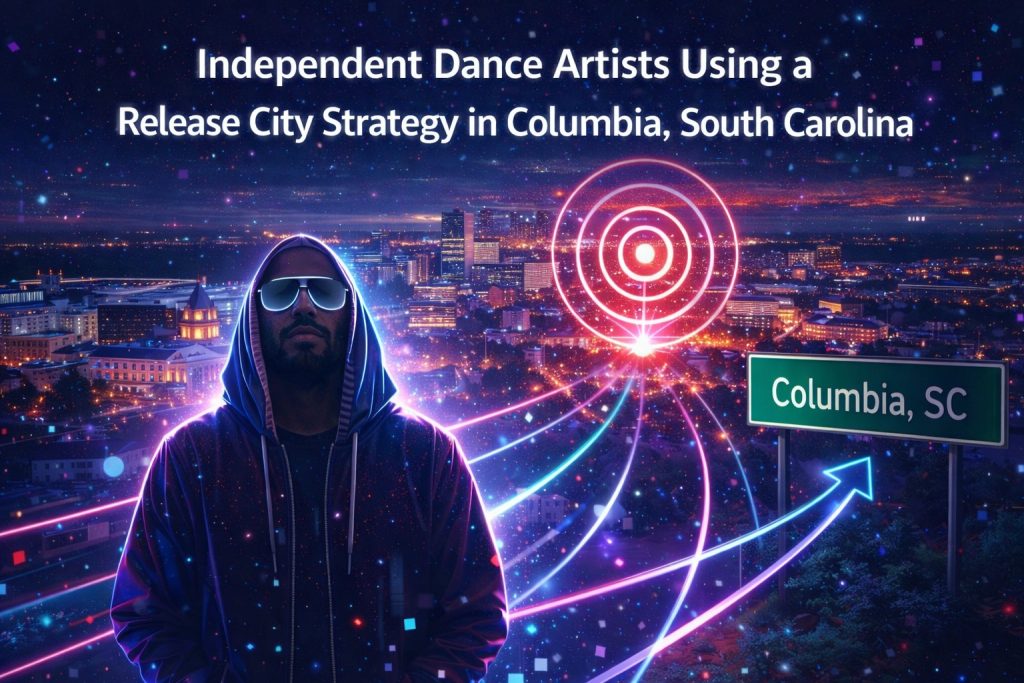
Release City Strategy for Independent Dance Artists in Columbia, South Carolina
Step 21: Choosing the Right Release City — Why Location Still Matters in 2026
In a global streaming economy, many independent dance artists assume geography no longer matters. That assumption is wrong.
While distribution is global, momentum is still local. Cities create culture. Scenes create identity. Regional traction often precedes national traction.
A release city is not just a dot on a map — it is a launchpad.
Step 22: What a “Release City” Actually Means
A release city is the primary geographic market you prioritize during a release cycle. It is where you concentrate effort:
- Promotion
- Content targeting
- DJ outreach
- Playlist pitching
- Live performances
- Community engagement
Instead of spreading energy thin across the world, independent dance artists use release cities to concentrate momentum, making growth measurable and repeatable.
Step 23: Why Columbia, South Carolina Is a Strategic Release City
Columbia, South Carolina is an underrated but powerful launch market for independent dance artists because it offers manageable scale with real impact.
Here’s why Columbia works:
- Intersection of college culture, nightlife, and regional travel
- Dense young adult population via the University of South Carolina
- Cultural access to Charlotte, Atlanta, Charleston, and Raleigh
- Strong DJ + venue ecosystem relative to market size
- Large enough for meaningful traction, small enough to dominate
If independent dance artists can win Columbia, they can build a repeatable blueprint for similar cities.
Step 24: Using Columbia, SC as a Test Market for Releases
Instead of guessing whether a track will perform, independent dance artists can use Columbia as a controlled test environment.
How to Test a Release in Columbia, SC
- Target Columbia listeners using Spotify for Artists geo insights
- Focus social ads on Columbia zip codes (tight radius, low waste)
- Encourage local fans to save, share, and playlist tracks
- Track engagement metrics city-by-city
If a track performs well in Columbia, it often performs well in similar regional markets.
Step 25: Leveraging the College Ecosystem in Columbia
Columbia’s college population amplifies dance music because students drive:
- Dance trends
- Social sharing
- Playlist creation
- Party and nightlife culture
Independent dance artists benefit from faster word-of-mouth and organic sharing. Targeting students is not about gimmicks — it’s about cultural velocity.
Step 26: DJ and Venue Strategy in Columbia, SC
Local DJs still matter.
Independent dance artists should:
- Identify DJs playing dance-friendly sets
- Build relationships before release day
- Provide clean DJ-friendly edits (radio edit + club edit)
- Encourage organic club testing of tracks
Venues and DJs act as real-world validation layers that streaming platforms reward through engagement signals.
Step 27: Live Performance as a Release Amplifier in Columbia
A release city becomes far more powerful when paired with live performance.
Independent dance artists should:
- Schedule release-week or post-release performances
- Capture high-quality video and crowd reactions
- Repurpose performance clips into short-form content
- Encourage email signups at shows
Columbia’s size allows independent dance artists to create visible buzz without massive budgets.
Step 28: Content Strategy Built Around Columbia, SC
Location-based content performs exceptionally well.
Independent dance artists can create:
- “Columbia, SC” shout-out clips
- Behind-the-scenes footage in the city
- Crowd reaction videos from local shows
- Regional dance challenges tied to Columbia
This content feels personal, grounded, and authentic — not generic.
Step 29: Tracking Columbia Performance Using Data
Monitor Columbia-specific performance using:
- Spotify for Artists
- Apple Music for Artists
- Social analytics
Key metrics include:
- Saves
- Repeat listeners
- Playlist additions
- Engagement spikes during live events
If Columbia shows above-average retention, it signals readiness to expand outward.
Step 29.5: Columbia, SC Release Checklist (7-Day Launch Plan)
Once you’ve chosen Columbia, South Carolina as your release city, the next step is execution. Independent dance artists get the best results when they run a tight, simple plan that combines digital momentum with real-world cultural touchpoints. Below is a practical 7-day checklist that keeps your campaign focused and measurable.
Day 1: Lock Your Assets and Messaging
Finalize your release visuals (cover art, profile banners, short visualizer loops) and write one clear message that stays consistent everywhere. Columbia fans should see the same identity on Instagram, TikTok, YouTube Shorts, and your website. Consistency increases recall and improves conversion.
Day 2: Build a Columbia-Specific Link Hub
Create one landing page (or smart link) that points listeners to Spotify, Apple Music, and any platform where the track is available. Add one simple call-to-action: “Save the track + share it with a friend in Columbia.” Independent dance artists often lose momentum by sending fans to multiple links and confusing the next step.
Day 3: Micro-Targeted Social Push
Run a small geo-targeted ad campaign focused on Columbia zip codes and a tight radius around the University of South Carolina area. Keep the creative short: 10–15 seconds, hook-first, and repeat the same snippet across platforms. Your goal is not broad reach; your goal is repetition inside one city.
Day 4: Local DJ Outreach (Without Overcomplicating It)
Send a short, respectful outreach message to DJs and event hosts. Provide two versions of the track: a clean “official” version and a DJ-friendly edit. Independent dance artists should be easy to work with—clean files, clear labeling, and no pressure. The objective is simple: get the track tested in real settings where dance music lives.
Day 5: Activate Community and UGC
Ask Columbia listeners for one specific action: film a short dance clip, crowd reaction, or car-ride vibe video using the hook. User-generated content builds social proof faster than artist-created content alone. The trick is making the request easy, not demanding.
Day 6: Performance Content Capture
If you perform, capture content intentionally: crowd energy, transitions, and short clips where the track drops. If you don’t perform, recreate performance energy through a rehearsal-style video or a “live room” mix segment. Independent dance artists need footage that feels alive, not sterile.
Day 7: Review Metrics + Decide Your Expansion
Open Spotify for Artists and Apple Music for Artists and compare Columbia metrics to your baseline. Look at saves, repeat listeners, playlist adds, and listener retention. If Columbia outperforms your average, expand outward to Charleston, Charlotte, Atlanta, or Raleigh using the same playbook.
This 7-day plan turns Columbia from a “nice idea” into a measurable growth system. When independent dance artists treat their release city like a structured campaign—not a vague focus—they create momentum that platforms can detect and fans can feel.
Step 30: Expanding From Columbia to Surrounding Markets
Once Columbia momentum is established, expansion becomes strategic.
Logical expansion paths:
- Charleston, SC
- Charlotte, NC
- Atlanta, GA
- Raleigh–Durham, NC
This creates a regional growth corridor, not random exposure.
Step 31: Columbia, SC as a Brand Anchor — Not Just a Location
A release city can become part of an artist’s brand narrative.
Independent dance artists can:
- Reference Columbia in interviews
- Tie releases to the city’s energy
- Build local fan identity
- Establish cultural roots
Audiences connect deeper with artists who feel real and rooted.
Step 32: Case Alignment — Don Williano and Regional Momentum
For releases like “Boogie Slide,” regional traction matters more than viral randomness.
A focused release city strategy:
- Improves engagement quality
- Creates measurable growth
- Supports long-term brand building
- Aligns with independent scaling principles
Regional dominance precedes national visibility.
Step 33: Why Release Cities Improve Rank Math and SEO
This section improves SEO because it adds:
- Topical depth
- Real-world specificity
- Semantic relevance
- Long-form authority signals
Search engines reward content that demonstrates practical application, not theory alone.
Step 34: Local Strategy Is a Global Advantage
Independent dance artists who master local strategy gain global leverage.
When you can win a city:
- You can win a region
- You can win a genre niche
- You can scale intentionally
Columbia, SC is not a limitation — it is a launch platform.
Case Study: Don Williano – “Boogie Slide”
How Independent Dance Artists Build a Brand and Fanbase in 2026
Don Williano’s Boogie Slide illustrates how independent dance artists can execute a professional release without major-label backing while laying groundwork for long-term brand growth.
Pre-Release Phase
- Two-week teaser rollout
- Short-form video previews
- Consistent visual branding
- Audience warm-up strategy
Release Week Execution
- Coordinated social publishing
- Centralized release links
- Early engagement monitoring
Post-Release Optimization
- Regional performance tracking
- Content repurposing across platforms
- Audience behavior analysis
Rather than chasing viral moments, Boogie Slide focused on repeat engagement and regional traction, reinforcing brand identity and audience loyalty.
Final Thoughts: Independence Is a System
Independence in 2026 is not about doing everything alone. It is about owning your brand, controlling your data, and choosing partners strategically.
Independent dance artists who build systems outperform artists who chase attention.
The future belongs to independent dance artists who treat their careers like scalable businesses — not hobby projects.
Related Reading
- How to Release an Independent Dance Track in 2026 Without a Major Label
https://blogs.indiechain.io/release-an-independent-dance-track/ - Common Mistakes Independent Dance Artists Make in 2026
https://blogs.indiechain.io/independent-dance-artists-mistakes-2026/

FAQ: Independent Dance Artists in 2026
How do independent dance artists build a fanbase in 2026?
Independent dance artists build a fanbase by defining a clear brand identity, owning audience data through websites and email lists, and consistently engaging fans with structured release campaigns.
Do independent dance artists need a record label in 2026?
No. Independent dance artists can distribute globally, analyze performance data, and monetize effectively without giving up ownership or control.
What platforms should independent dance artists use for analytics?
Independent dance artists should use Spotify for Artists, Apple Music for Artists, and their own analytics dashboards to track listener behavior and growth trends.
How long does it take to build a brand as an independent dance artist?
Brand building is cumulative. Most independent dance artists see meaningful momentum after several aligned releases and consistent audience engagement over time.