

1 million streams sounds huge — but how much money does it actually make? Many independent artists assume that reaching a million streams on Spotify will automatically translate into massive earnings. In reality, streaming revenue is far more complex. The amount an artist earns can vary widely depending on factors like listener location, subscription type, label agreements, and distribution fees.
If you’ve ever wondered how much does Spotify pay per stream, you’re not alone. It’s one of the most searched questions among musicians, producers, and music marketers trying to understand the economics of modern streaming platforms. On average, Spotify pay per stream ranges between $0.003 and $0.005, but the actual money per stream Spotify pays can fluctuate depending on several variables within its royalty distribution model.
For emerging artists and independent creators, understanding how Spotify calculates royalties is essential for building a sustainable music career. Streaming numbers may look impressive on dashboards, but the real value lies in how those streams convert into revenue and long-term audience growth.
In this comprehensive guide, we will break down everything you need to know about Spotify streaming earnings. You’ll learn:
- The real Spotify payout rates in 2026
- How a Spotify stream calculator estimates potential earnings
- Real-world revenue examples from thousands to millions of streams
- The key factors affecting royalties on Spotify
- Practical strategies artists use to increase streaming income
By the end of this guide, you’ll have a clear understanding of how streaming numbers translate into real money — and how artists can maximize their revenue in today’s digital music economy.
Spotify Pay Per Stream: The Real Numbers in 2026
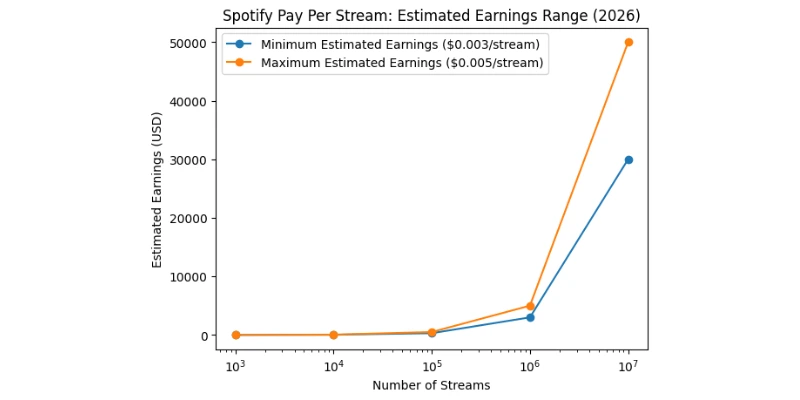
To understand how much does Spotify pay per stream, it’s important to first look at the typical payout range used in the music streaming industry. While the exact amount varies, the average Spotify pay per stream generally falls between $0.003 and $0.005 per play. This means artists need a significant number of streams before generating substantial income.
Here is a simple breakdown of estimated earnings based on common streaming volumes:
| Streams | Estimated Earnings |
|---|---|
| 1,000 streams | $3 – $5 |
| 10,000 streams | $30 – $50 |
| 100,000 streams | $300 – $500 |
| 1 million streams | $3,000 – $5,000 |
These numbers illustrate why understanding money per stream Spotify pays is crucial for artists planning their release and promotion strategies.
The Spotify Pro-Rata Payment Model
Spotify uses a pro-rata royalty system, which means revenue from subscriptions and ads is pooled together and then distributed based on the total share of streams each artist receives. Instead of paying a fixed rate per stream, Spotify calculates payouts as a percentage of overall platform revenue.
For example, if your music accounts for 1% of all streams on Spotify during a specific period, you would receive roughly 1% of the royalty pool allocated to rights holders.
Why Spotify Payouts Fluctuate
The reason the Spotify pay per stream figure is often presented as a range rather than a fixed number is because multiple variables influence the final payout:
1. Listener Location
Streams from countries with higher subscription prices typically generate more revenue than those from regions with lower pricing.
2. Premium vs Free Users
Premium subscribers generate more revenue per stream than ad-supported free listeners.
3. Distributor Fees
Music distributors such as DistroKid, TuneCore, or CD Baby often take a percentage or annual fee from streaming revenue before the artist receives their share.
4. Label and Publishing Splits
If an artist is signed to a label, royalties may be divided among record labels, publishers, and other rights holders before reaching the artist.
Because of these factors, two artists with the same number of streams may earn very different amounts. Understanding how these elements affect Spotify streaming revenue is key to building a profitable music strategy.
Spotify Royalty Calculator: Estimate Your Earnings
Understanding how Spotify streams translate into money can feel confusing, which is why many artists rely on a Spotify royalty calculator or Spotify stream calculator to estimate their potential earnings. While Spotify does not publish an exact fixed rate per play, most industry estimates place the payout between $0.003 and $0.005 per stream.
The basic formula used in any spotify streams to money calculation looks like this:
Earnings = Total Streams × Average Pay Per Stream
Using this formula gives a rough estimate of how much revenue a track might generate before distributor fees, label splits, or publishing royalties are deducted.
Here are some realistic examples:
| Streams | Estimated Earnings |
|---|---|
| 500,000 streams | $1,500 – $2,500 |
| 2,000,000 streams | $6,000 – $10,000 |
| 10,000,000 streams | $30,000 – $50,000 |
For instance, if your song reaches 500k streams, the expected earnings might fall between $1,500 and $2,500, depending on listener location and subscription type. Similarly, a viral track hitting 10 million streams could generate anywhere from $30,000 to $50,000 before revenue splits.
A simple Spotify royalty calculator works by letting artists input their total streams and multiplying that number by an average payout value. While this estimate isn’t perfectly accurate, it provides a useful benchmark for musicians trying to understand the financial impact of their streaming numbers.
Using a spotify stream calculator can also help artists set realistic revenue goals. Instead of focusing only on stream counts, musicians can see exactly how their audience growth converts into real income.
How Much Money Is 100 Thousand Streams on Spotify?
One of the most common questions artists ask is how much money is 100 thousand streams on Spotify. While the exact amount varies, most estimates place the payout between $300 and $500 for 100,000 streams.
Here’s a quick breakdown of typical earnings when converting Spotify streams to money:
| Streams | Estimated Revenue |
|---|---|
| 100,000 streams | $300 – $500 |
| 250,000 streams | $750 – $1,250 |
| 500,000 streams | $1,500 – $2,500 |
At first glance, these numbers may seem modest. However, streaming revenue often grows as an artist’s catalog expands and songs accumulate plays over time.
Two major factors influence how much spotify streams convert to money:
Playlist Influence
Editorial and algorithmic playlists can dramatically increase a song’s stream count. Tracks placed on large Spotify playlists often generate hundreds of thousands — or even millions — of streams, significantly boosting potential earnings.
Country-Based Streaming Rates
Spotify payouts are also affected by where listeners are located. Streams from countries with higher subscription prices, such as the United States or the United Kingdom, typically generate more revenue compared to streams from regions where subscription costs are lower.
Because of these variables, two artists with the same number of streams may earn different amounts. Understanding how audience geography and playlist exposure affect revenue is essential for maximizing Spotify income.
How Much Money Is a Million Streams on Spotify?
Reaching 1 million streams on Spotify is a major milestone for many musicians. But a common question remains: how much money is a million streams on Spotify, and how much money do you make on Spotify at that level?
On average, 1 million streams generate between $3,000 and $5,000 in gross revenue before deductions. The exact payout depends on several factors, including listener location, subscription types, and royalty splits.
Here’s an example of how earnings might look for an independent artist releasing music through a distribution platform:
| Category | Share |
|---|---|
| Spotify payout | $4,000 |
| Distributor fee | $400 |
| Artist receives | $3,600 |
In this scenario, the distributor takes roughly 10% of the revenue, leaving the artist with around $3,600 in net earnings from one million streams.
However, artists signed to record labels may see a much smaller share of the total revenue. Labels often take a large percentage of streaming royalties to cover production, marketing, and distribution costs. In some contracts, artists may receive only 10–20% of total streaming income, meaning a million streams could result in a significantly lower payout.
Because of these industry structures, understanding how much money you make on Spotify requires looking beyond stream counts and considering the entire royalty chain. Independent artists who maintain ownership of their music typically keep a much larger portion of their streaming income compared to artists working under traditional label agreements.
How Much Does an Artist Get From Spotify?

A common question in the music industry is how much does an artist get from Spotify. While many people assume the artist receives the full streaming payout, the reality is more complex. Streaming revenue passes through several stakeholders before reaching the artist, which means the final amount can vary significantly.
If you’re wondering how much money do you make on Spotify, the answer depends on multiple factors such as record deals, distribution services, and publishing rights. Spotify itself does not pay artists directly in most cases. Instead, it distributes royalties to rights holders, who then allocate the revenue according to contractual agreements.
A simplified breakdown of Spotify’s revenue distribution looks like this:
| Stakeholder | Percentage |
|---|---|
| Spotify platform | ~30% |
| Rights holders (labels, publishers, artists) | ~70% |
From that 70%, the revenue is typically split among several parties:
Record Labels
Labels often control the master recording rights and usually receive the largest share of streaming income.
Publishers and Songwriters
A portion of the revenue is allocated to the composition rights, which go to songwriters and publishers.
Distributors
Independent artists often use distributors such as DistroKid or TuneCore, which may charge a flat annual fee or take a percentage of royalties.
Independent Artists vs Signed Artists
Independent artists who release music without a label usually retain a much larger portion of their earnings. After distributor fees, they may keep 80–90% of streaming revenue.
Signed artists, however, often operate under traditional label contracts. In many cases, they may receive only 10–20% of total streaming royalties after the label recovers production, marketing, and promotion expenses.
Because of these different structures, the amount an artist actually receives from Spotify can vary widely even when two songs generate the same number of streams.
How Much Does 50 Million Monthly Listeners on Spotify Pay?
Many people assume that monthly listeners directly determine how much an artist earns, but that isn’t exactly how the platform works. When discussing Spotify Pay Per Stream, it’s important to understand that monthly listeners are not the same as streams.
Monthly listeners simply represent the number of unique users who listened to an artist within a 28-day period. However, revenue is calculated based on the total number of streams generated by those listeners, which is the foundation of the Spotify Pay Per Stream model.
For example, imagine an artist with 50 million monthly listeners. If each listener streams an average of three songs per month, the total streams could look like this:
50 million listeners × 3 streams = 150 million streams
Based on the estimated Spotify Pay Per Stream average of around $0.003–$0.005, the potential revenue could be calculated like this:
150 million streams × $0.0035 = approximately $525,000
This example shows how Spotify Pay Per Stream earnings are driven by total streams rather than listener counts alone.
However, actual payouts can vary significantly due to several factors:
- Geographic location of listeners
- Premium vs. free Spotify users
- Revenue splits with record labels and publishers
- Distributor platform fees
Because of these variables, two artists with similar monthly listener numbers may earn very different amounts, even under the same Spotify Pay Per Stream structure.
In simple terms, monthly listeners show popularity, but streams determine real Spotify revenue.
Spotify Streams to Money: Real Earnings Examples
Understanding spotify streams to money conversions helps artists set realistic expectations about streaming revenue. Because the average money per stream Spotify pays is relatively small, substantial income usually requires millions of plays.
Here are some common examples of how streaming numbers translate into revenue:
| Streams | Estimated Revenue |
|---|---|
| 10,000 | $35 |
| 50,000 | $175 |
| 100,000 | $350 |
| 500,000 | $1,750 |
| 1,000,000 | $3,500 |
| 10,000,000 | $35,000 |
These estimates are based on the average Spotify Pay Per Stream rate of about $0.003–$0.005, with many analysts using $0.0035 per stream as a realistic benchmark. However, the exact Spotify Pay Per Stream payout can fluctuate depending on factors such as Spotify’s overall revenue pool, subscription levels, and listener demographics.
In many cases, a single viral track can significantly increase an artist’s Spotify Pay Per Stream earnings. Songs that gain traction through social media platforms or major playlists can quickly accumulate millions of plays within a short period. When a track goes viral, it may reach tens of millions of streams, which dramatically boosts revenue under the Spotify Pay Per Stream model while also expanding the artist’s global audience.
That said, long-term success on streaming platforms rarely depends on just one hit song. Most successful musicians focus on building a strong music catalog where multiple tracks continue generating streams over time. This approach maximizes Spotify Pay Per Stream income, as each song contributes to ongoing streaming revenue and helps create a consistent and sustainable income stream for artists.
Factors That Affect Spotify Pay Per Stream
Although the average Spotify pay per stream falls between $0.003 and $0.005, the exact payout varies depending on several important factors within the streaming ecosystem.
Listener Location
One of the biggest influences on streaming revenue is where listeners are located. Streams from countries with higher subscription prices — such as the United States, Canada, and Western Europe — generally generate more revenue than streams from regions with lower subscription costs.
For example, a stream from the United States may generate significantly more revenue than a stream from a country where Spotify’s premium subscription is priced much lower.
Premium vs Free Users
Spotify operates with two types of listeners: premium subscribers and ad-supported free users. Premium users pay monthly subscription fees, which contribute directly to the royalty pool. As a result, streams from premium accounts typically generate higher payouts than those from free listeners supported by advertisements.
Distributor Fees
Most independent artists distribute their music through third-party platforms. These services deliver music to streaming platforms and collect royalties on behalf of the artist.
Common distributors include:
- DistroKid
- TuneCore
- CD Baby
Depending on the platform, distributors may charge either an annual subscription fee or a percentage of the artist’s earnings.
Label Deals and Royalty Splits
Artists signed to record labels often share streaming revenue with their label partners. Labels typically fund production, marketing, and promotion, and in return they take a substantial share of royalties.
In some cases, artists may receive only 10–20% of the total streaming revenue, with the remaining portion going to labels, publishers, and other rights holders. This is why independent artists often retain a larger portion of their Spotify pay per stream earnings.
How Artists Increase Spotify Earnings

While the payout per stream on Spotify may seem small, successful musicians use multiple strategies to increase their streaming numbers and overall revenue. Effective music promotion plays a crucial role in helping artists reach new audiences and generate consistent streams.
Playlist Placements
Getting featured on popular Spotify playlists can significantly boost streams. Editorial playlists curated by Spotify and large user-generated playlists often introduce songs to thousands or even millions of listeners.
TikTok and Social Media Virality
Short-form video platforms such as TikTok have become powerful discovery tools for music. Viral trends frequently drive massive traffic to Spotify, helping songs accumulate millions of streams in a short time.
Collaborations With Other Artists
Collaborating with artists who already have established audiences can expand reach and introduce music to new listener groups. This strategy often leads to higher streaming numbers and stronger fan engagement.
Social Media Audience Growth
Building a strong presence on platforms like Instagram, YouTube, and TikTok allows artists to maintain direct relationships with their audience. When fans actively support new releases, streams tend to grow quickly after each launch.
Targeted Streaming Campaigns
Many artists invest in structured music promotion campaigns that focus on playlist pitching, influencer collaborations, and digital marketing strategies designed specifically to increase streaming activity.
When these strategies are combined, they can dramatically increase streaming numbers and help artists maximize their revenue from Spotify.
Preparing Your Music for Spotify Distribution
Before a song can generate streams and revenue, it must first be properly prepared for release. The process of Preparing Your Track for Distribution plays a crucial role in ensuring your music performs well on streaming platforms.
Several key elements should be finalized before submitting music to Spotify:
Professional Mastering
A professionally mastered track ensures that your music meets the technical standards required by streaming platforms. Proper mastering also improves audio clarity and consistency across different playback systems.
Accurate Metadata
Metadata includes essential information such as the artist name, song title, contributors, and genre tags. Correct metadata helps streaming platforms categorize your music and makes it easier for listeners to discover your tracks.
High-Quality Artwork
Spotify requires album or single artwork that meets specific resolution and formatting standards. Professional cover art not only satisfies platform requirements but also strengthens the visual identity of your release.
ISRC Codes
An International Standard Recording Code (ISRC) acts as a unique identifier for each track. This code helps ensure accurate royalty tracking across streaming services.
Proper preparation during this stage can significantly improve the chances of your music being discovered and streamed on major platforms.
Protecting Your Music Revenue
As streaming becomes the dominant form of music consumption, protecting intellectual property is more important than ever. Artists must ensure that their work is properly secured so that streaming revenue flows to the rightful rights holders.
One way to safeguard music earnings is through digital music authentication services, which help verify ownership and prevent unauthorized distribution of songs online.
Key protection methods include:
Copyright Registration
Registering music with copyright authorities establishes legal ownership of both the composition and the master recording.
Blockchain-Based Verification
Some platforms now use blockchain technology to create transparent ownership records. This technology allows artists to track how their music is distributed and monetized across digital platforms.
Anti-Piracy Monitoring
Unauthorized uploads or piracy can divert streams away from official releases. Anti-piracy tools monitor the internet for illegal copies and help ensure that streams are directed to legitimate versions of the music.
By combining these protection strategies, artists can safeguard their intellectual property and ensure they receive the full value of their streaming revenue.
Spotify vs Other Streaming Platforms (Royalties Comparison)
Although Spotify is the world’s largest music streaming platform, it is not the only service paying royalties to artists. Different platforms offer different payout rates depending on their revenue models and subscriber bases.
Here is a general comparison of estimated streaming payouts across major platforms:
| Platform | Pay Per Stream |
|---|---|
| Spotify | $0.003 – $0.005 |
| Apple Music | $0.006 – $0.01 |
| YouTube Music | ~$0.0007 |
| Amazon Music | ~$0.004 |
Apple Music generally pays higher per-stream royalties because it operates primarily on a premium subscription model with fewer free users. Spotify, by contrast, has a large ad-supported user base, which slightly lowers the average payout per stream.
YouTube Music typically generates lower revenue per stream due to its heavy reliance on advertising. However, YouTube offers strong discovery potential through its massive global audience.
Amazon Music sits somewhere in the middle, offering competitive payouts while continuing to grow its subscriber base.
For artists, distributing music across multiple platforms is often the best strategy. Diversifying streaming sources not only increases exposure but also allows musicians to maximize overall revenue from digital streaming.
How Much Does an Artist Get From Spotify?
A common question in the music industry is how much does an artist get from Spotify. While many people assume the artist receives the full streaming payout, the reality is more complex. Streaming revenue passes through several stakeholders before reaching the artist, which means the final amount can vary significantly.
If you’re wondering how much money do you make on Spotify, the answer depends on multiple factors such as record deals, distribution services, and publishing rights. Spotify itself does not pay artists directly in most cases. Instead, it distributes royalties to rights holders, who then allocate the revenue according to contractual agreements.
A simplified breakdown of Spotify’s revenue distribution looks like this:
| Stakeholder | Percentage |
|---|---|
| Spotify platform | ~30% |
| Rights holders (labels, publishers, artists) | ~70% |
From that 70%, the revenue is typically split among several parties:
Record Labels
Labels often control the master recording rights and usually receive the largest share of streaming income.
Publishers and Songwriters
A portion of the revenue is allocated to the composition rights, which go to songwriters and publishers.
Distributors
Independent artists often use distributors such as DistroKid or TuneCore, which may charge a flat annual fee or take a percentage of royalties.
Independent Artists vs Signed Artists
Independent artists who release music without a label usually retain a much larger portion of their earnings. After distributor fees, they may keep 80–90% of streaming revenue.
Signed artists, however, often operate under traditional label contracts. In many cases, they may receive only 10–20% of total streaming royalties after the label recovers production, marketing, and promotion expenses.
Because of these different structures, the amount an artist actually receives from Spotify can vary widely even when two songs generate the same number of streams.
How Much Does 50 Million Monthly Listeners on Spotify Pay?
Many people assume that monthly listeners directly determine how much money an artist earns, but that isn’t exactly how Spotify’s system works. When asking how much does 50 million monthly listeners on Spotify pay, it’s important to understand that monthly listeners are not the same as streams.
Monthly listeners simply represent the number of unique users who listened to an artist during a 28-day period. The real revenue comes from the total number of streams those listeners generate.
For example, imagine an artist with 50 million monthly listeners. If each listener streams an average of three songs per month, the total stream count would look like this:
50 million listeners × 3 streams = 150 million streams
Using a typical average payout of $0.0035 per stream, the estimated revenue could be calculated as:
150 million streams × $0.0035 = approximately $525,000
However, this figure can vary widely depending on several factors:
- The geographic location of listeners
- Whether streams come from premium or free users
- Revenue splits with labels and publishers
- Distributor service fees
Because of these variables, two artists with similar monthly listener numbers may generate very different levels of streaming income.
Spotify Streams to Money: Real Earnings Examples
Understanding spotify streams to money conversions helps artists set realistic expectations about streaming revenue. Because the average money per stream Spotify pays is relatively small, substantial income usually requires millions of plays.
Here are some common examples of how streaming numbers translate into revenue:
| Streams | Estimated Revenue |
|---|---|
| 10,000 | $35 |
| 50,000 | $175 |
| 100,000 | $350 |
| 500,000 | $1,750 |
| 1,000,000 | $3,500 |
| 10,000,000 | $35,000 |
These estimates assume an average payout of around $0.0035 per stream, though the actual figure may fluctuate slightly depending on Spotify’s revenue pool and listener demographics.
In many cases, a single viral song can dramatically increase an artist’s earnings. Tracks that gain traction through social media platforms or popular playlists can accumulate millions of streams in a relatively short period of time. Viral hits often reach tens of millions of plays, generating significant streaming revenue and expanding an artist’s audience globally.
However, successful artists rarely rely on just one song. Instead, they build a catalog of tracks that continue generating streams over time. This cumulative streaming strategy is what allows many musicians to turn Spotify plays into a steady source of income.
Factors That Affect Spotify Pay Per Stream
Although the average Spotify pay per stream falls between $0.003 and $0.005, the exact payout varies depending on several important factors within the streaming ecosystem.
Listener Location
One of the biggest influences on streaming revenue is where listeners are located. Streams from countries with higher subscription prices — such as the United States, Canada, and Western Europe — generally generate more revenue than streams from regions with lower subscription costs.
For example, a stream from the United States may generate significantly more revenue than a stream from a country where Spotify’s premium subscription is priced much lower.
Premium vs Free Users
Spotify operates with two types of listeners: premium subscribers and ad-supported free users. Premium users pay monthly subscription fees, which contribute directly to the royalty pool. As a result, streams from premium accounts typically generate higher payouts than those from free listeners supported by advertisements.
Distributor Fees
Most independent artists distribute their music through third-party platforms. These services deliver music to streaming platforms and collect royalties on behalf of the artist.
Common distributors include:
- DistroKid
- TuneCore
- CD Baby
Depending on the platform, distributors may charge either an annual subscription fee or a percentage of the artist’s earnings.
Label Deals and Royalty Splits
Artists signed to record labels often share streaming revenue with their label partners. Labels typically fund production, marketing, and promotion, and in return they take a substantial share of royalties.
In some cases, artists may receive only 10–20% of the total streaming revenue, with the remaining portion going to labels, publishers, and other rights holders. This is why independent artists often retain a larger portion of their Spotify pay per stream earnings.
How Artists Increase Spotify Earnings
While the payout per stream on Spotify may seem small, successful musicians use multiple strategies to increase their streaming numbers and overall revenue. Effective music promotion plays a crucial role in helping artists reach new audiences and generate consistent streams.
Playlist Placements
Getting featured on popular Spotify playlists can significantly boost streams. Editorial playlists curated by Spotify and large user-generated playlists often introduce songs to thousands or even millions of listeners.
TikTok and Social Media Virality
Short-form video platforms such as TikTok have become powerful discovery tools for music. Viral trends frequently drive massive traffic to Spotify, helping songs accumulate millions of streams in a short time.
Collaborations With Other Artists
Collaborating with artists who already have established audiences can expand reach and introduce music to new listener groups. This strategy often leads to higher streaming numbers and stronger fan engagement.
Social Media Audience Growth
Building a strong presence on platforms like Instagram, YouTube, and TikTok allows artists to maintain direct relationships with their audience. When fans actively support new releases, streams tend to grow quickly after each launch.
Targeted Streaming Campaigns
Many artists invest in structured music promotion campaigns that focus on playlist pitching, influencer collaborations, and digital marketing strategies designed specifically to increase streaming activity.
When these strategies are combined, they can dramatically increase streaming numbers and help artists maximize their revenue from Spotify.
Preparing Your Music for Spotify Distribution
Before a song can generate streams and revenue, it must first be properly prepared for release. The process of Preparing Your Track for Distribution plays a crucial role in ensuring your music performs well on streaming platforms.
Several key elements should be finalized before submitting music to Spotify:
Professional Mastering
A professionally mastered track ensures that your music meets the technical standards required by streaming platforms. Proper mastering also improves audio clarity and consistency across different playback systems.
Accurate Metadata
Metadata includes essential information such as the artist name, song title, contributors, and genre tags. Correct metadata helps streaming platforms categorize your music and makes it easier for listeners to discover your tracks.
High-Quality Artwork
Spotify requires album or single artwork that meets specific resolution and formatting standards. Professional cover art not only satisfies platform requirements but also strengthens the visual identity of your release.
ISRC Codes
An International Standard Recording Code (ISRC) acts as a unique identifier for each track. This code helps ensure accurate royalty tracking across streaming services.
Proper preparation during this stage can significantly improve the chances of your music being discovered and streamed on major platforms.
Protecting Your Music Revenue
As streaming becomes the dominant form of music consumption, protecting intellectual property is more important than ever. Artists must ensure that their work is properly secured so that streaming revenue flows to the rightful rights holders.
One way to safeguard music earnings is through digital music authentication services, which help verify ownership and prevent unauthorized distribution of songs online.
Key protection methods include:
Copyright Registration
Registering music with copyright authorities establishes legal ownership of both the composition and the master recording.
Blockchain-Based Verification
Some platforms now use blockchain technology to create transparent ownership records. This technology allows artists to track how their music is distributed and monetized across digital platforms.
Anti-Piracy Monitoring
Unauthorized uploads or piracy can divert streams away from official releases. Anti-piracy tools monitor the internet for illegal copies and help ensure that streams are directed to legitimate versions of the music.
By combining these protection strategies, artists can safeguard their intellectual property and ensure they receive the full value of their streaming revenue.
Spotify vs Other Streaming Platforms (Royalties Comparison)
Although Spotify is the world’s largest music streaming platform, it is not the only service paying royalties to artists. Different platforms offer different payout rates depending on their revenue models and subscriber bases.
Here is a general comparison of estimated streaming payouts across major platforms:
| Platform | Pay Per Stream |
|---|---|
| Spotify | $0.003 – $0.005 |
| Apple Music | $0.006 – $0.01 |
| YouTube Music | ~$0.0007 |
| Amazon Music | ~$0.004 |
Apple Music generally pays higher per-stream royalties because it operates primarily on a premium subscription model with fewer free users. Spotify, by contrast, has a large ad-supported user base, which slightly lowers the average payout per stream.
YouTube Music typically generates lower revenue per stream due to its heavy reliance on advertising. However, YouTube offers strong discovery potential through its massive global audience.
Amazon Music sits somewhere in the middle, offering competitive payouts while continuing to grow its subscriber base.
For artists, distributing music across multiple platforms is often the best strategy. Diversifying streaming sources not only increases exposure but also allows musicians to maximize overall revenue from digital streaming.
FAQ: Spotify Streaming Earnings
Below are some of the most frequently asked questions about Spotify payouts. These answers help explain how much money artists can realistically earn from streaming and how Spotify streams convert to real revenue.
How much does Spotify pay per 1000 streams?
Spotify typically pays between $3 and $5 for every 1,000 streams. This estimate is based on the average Spotify pay per stream, which generally ranges from $0.003 to $0.005 per play. However, the exact amount can vary depending on factors such as listener location, whether the stream comes from a premium subscriber or a free user, and the royalty splits between labels, publishers, and distributors.
How much money is 10 million streams on Spotify?
If a song reaches 10 million streams on Spotify, it can generate roughly $30,000 to $50,000 in gross revenue. The final earnings depend on the average payout per stream and any deductions from distributors or record labels. Independent artists who own their masters usually keep a larger share of these earnings compared to artists signed to traditional record deals.
Do artists make money from Spotify?
Yes, artists do make money from Spotify, but the income depends heavily on streaming volume and royalty agreements. Spotify distributes about 70% of its revenue to rights holders, which include record labels, publishers, and independent artists. The actual payment received by the artist depends on how those royalties are divided. Independent artists often earn more per stream because they control their master recordings.
How many streams make $1,000 on Spotify?
To earn approximately $1,000 from Spotify, an artist typically needs around 250,000 to 300,000 streams. This estimate assumes an average payout of about $0.0035 per stream. However, the exact number of streams required can vary depending on listener geography, subscription types, and revenue splits with distributors or record labels.
Can artists make a living from Spotify streaming?
Yes, but it usually requires millions of streams or a large catalog of music. Most successful artists combine Spotify income with other revenue sources such as live performances, merchandise sales, brand collaborations, and licensing deals. Streaming platforms often serve as a discovery engine that helps artists grow their audience and increase income across multiple channels.
Why does Spotify pay different amounts per stream?
Spotify does not pay a fixed rate per stream because it uses a pro-rata payment system. Revenue from subscriptions and advertisements is pooled together and distributed to rights holders based on their share of total streams on the platform. As a result, payouts can vary depending on overall platform revenue, user subscription levels, and the geographic distribution of listeners.
Final Thoughts: Is Spotify Still Profitable for Artists?
The modern streaming economy has fundamentally changed how musicians earn money from their work. While the Spotify pay per stream rate may seem small on an individual level, the platform still offers one of the largest global audiences for music discovery. Millions of artists use Spotify not only as a revenue source but also as a powerful promotional tool to build fanbases and expand their reach.
However, relying solely on streaming income is rarely enough for most musicians. Successful artists typically diversify their revenue streams by combining Spotify earnings with other income sources. These can include live performances, brand partnerships, digital sales, licensing deals, and fan memberships. In particular, touring and merchandise sales often generate significantly higher profits than streaming alone.
Spotify plays a critical role in this ecosystem by helping artists grow visibility. A track that gains traction on playlists or social media can drive new listeners, boost concert ticket sales, and increase merchandise demand.
Ultimately, Spotify works best when viewed as one part of a larger music business strategy rather than the only revenue channel. Artists who focus on audience growth, consistent releases, and strong promotion strategies are far more likely to turn streaming success into long-term financial sustainability.
If you’re serious about maximizing your streaming revenue and building a scalable music career, start optimizing your distribution, promotion, and royalty management strategy today.