
In 2026, the music industry is undergoing a seismic shift, driven by technological advancements that promise to rectify decades-old injustices faced by creators. Gone are the days when artists waited endlessly for royalty checks, entangled in bureaucratic red tape and opaque accounting practices. Blockchain-powered music platforms have risen as a beacon of hope, integrating decentralized ledgers with smart contracts to automate royalty distributions. This innovation not only accelerates payments but also ensures transparency and fairness in an ecosystem historically skewed toward intermediaries.
The global music market, projected to surpass $50 billion by 2026 according to industry reports, is dominated by streaming, which accounts for over 70% of revenues. Yet, despite this growth, artists often receive mere pennies per stream, with payments delayed by months due to complex settlement processes. Blockchain-powered music platforms address these pain points head-on by embedding royalty logic into immutable smart contracts, allowing for real-time, automated payouts without human intervention.
This comprehensive guide delves into the mechanics of these platforms, exploring their evolution, technical underpinnings, and future implications. Drawing from over two decades of insights in IT and blockchain, we’ll unpack how smart contracts are transforming music royalties. Whether you’re an aspiring artist in the USA navigating the indie scene, a music startup founder seeking scalable solutions, or an investor evaluating blockchain’s potential in entertainment, this article provides actionable knowledge to thrive in 2026’s music landscape. We’ll cover everything from historical failures to cutting-edge implementations, ensuring a balanced view that highlights both opportunities and challenges.
The Music Royalty System Before Blockchain (Why It Failed Artists)
To fully grasp the revolutionary impact of blockchain, it’s essential to revisit the antiquated systems that preceded it. These traditional models, rooted in the vinyl era, have struggled to adapt to digital realities, leaving artists vulnerable to exploitation and inefficiency.
How Traditional Music Royalties Work
The conventional royalty pipeline is a labyrinthine network involving multiple stakeholders. Major labels like Universal or Sony oversee production, marketing, and distribution, taking significant cuts—often 80-90% for new artists. Publishers handle songwriting rights, ensuring composers get paid for reproductions. PROs such as ASCAP, BMI, or PRS collect performance royalties from radio, live events, and streaming.
The process unfolds in cumbersome cycles: platforms report usage data quarterly, PROs aggregate and verify it, then distribute funds based on ownership agreements. Mechanical royalties cover physical or digital copies, while sync fees apply to media placements like ads or films. Calculations factor in variables like territory, usage type, and splits, all managed in siloed databases. Cross-border transactions introduce additional complexities, including exchange rates, withholding taxes, and compliance with varying intellectual property laws.
This manual-heavy approach, reliant on spreadsheets and audits, is prone to errors. For instance, a single track might involve dozens of rights holders, each requiring precise allocation.
Common Royalty Problems Faced by Artists
Artists bear the brunt of these inefficiencies. Payment delays are notorious; earnings from a viral hit might not arrive for 6-12 months, forcing creators to seek advances or loans. Transparency is another casualty—statements often provide aggregated figures without breakdowns, making it impossible to verify if streams from US to the World were accurately counted.
Disputes over ownership percentages are commonplace, especially in collaborations where verbal agreements lead to legal battles. Cross-border issues amplify problems: an artist in the US might lose 20-30% to fees when royalties cross from the US, with currency fluctuations adding volatility. Independent musicians, without label backing, face the worst outcomes, often settling for unfavorable deals just to get paid.
Data from organizations like the Artist Rights Alliance highlights that up to 50% of royalties never reach creators due to “black box” funds—unattributable earnings held by PROs.
Why Streaming Platforms Didn’t Solve the Core Problem
The advent of streaming in the 2010s promised democratization, but it fell short. Services like Spotify centralize data control, using proprietary algorithms to determine royalty pools. Artists receive pro-rata shares based on total streams, disadvantaged niche genres.
Centralization means platforms dictate terms: labels negotiate better rates, leaving independents with scraps. Payments remain batched, with artists last in line after platforms and intermediaries take their shares. Opaque “discovery mode” features further erode earnings by reducing payouts for algorithmic promotion.
In essence, streaming amplified volume but not equity, perpetuating a system where superstars thrive while mid-tier artists struggle.
What Are Blockchain-Powered Music Platforms?
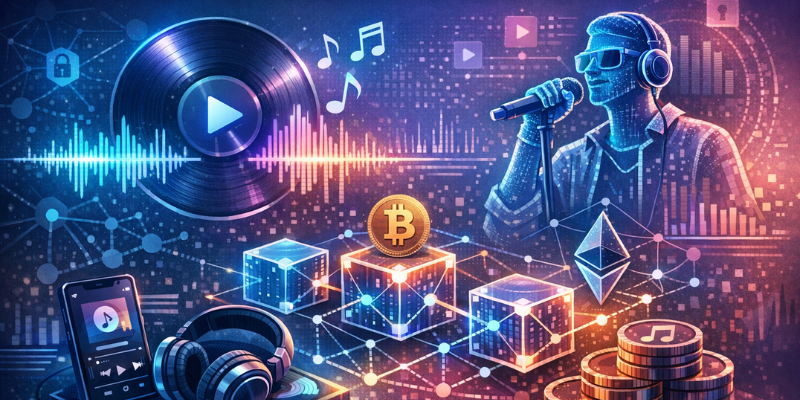
Blockchain-powered music platforms flip the script, decentralizing control and prioritizing creators through innovative tech stacks.
Definition and Core Components
These platforms operate on distributed ledgers, where every transaction is recorded across a network of nodes, ensuring immutability and security. Core elements include tokenized assets—songs as NFTs or fungible tokens carrying metadata like ISRC codes, lyrics, and artwork. The decentralized ledger tracks ownership and usage, while smart contracts automate agreements.
In 2026, integration with Web3 wallets allows seamless interactions. Platforms like Audius or Ujo Music exemplify this, with DAOs enabling community governance. Immutable metadata prevents tampering, and interoperability standards like those from Open Music Initiative ensure cross-platform compatibility.
How Blockchain-Powered Music Platforms Differ from Traditional Platforms
Traditional platforms are gatekept silos; blockchain-powered music platforms are open ecosystems. Ownership-first models let artists mint tracks directly, retaining 100% control unless they choose to share. Revenue flows transparently: every stream is a verifiable on-chain event, contrasting with black-box calculations.
Trustless execution eliminates middlemen—payouts happen automatically via code, not contracts enforced by lawyers. This democratizes access: an indie artist in the US can distribute globally without label deals, earning in crypto or fiat. Scalability via layer-2 solutions handles millions of micro-transactions, something centralized servers struggle with during peaks.
Blockchain-powered music platforms also foster fan engagement through token-gated content, turning listeners into stakeholders.
Understanding Smart Contracts in the Music Industry
Smart contracts are the automation engine, bridging code and commerce in music.
What Is a Smart Contract?
Coined by Nick Szabo in the 1990s, a smart contract is code that self-executes when conditions are met, deployed on blockchains like Ethereum. It’s like a vending machine: input (e.g., a stream) triggers output (payout) without oversight.
In practice, languages like Solidity define logic, with blockchain consensus validating execution. Immutability ensures once-live contracts can’t be altered, providing ironclad reliability.
Why Smart Contracts Are Ideal for Music Royalties
Deterministic outcomes mean predictable payouts—every play yields the exact split. Anti-manipulation features stem from cryptographic security, deterring fraud. Real-time settlement, enabled by fast blockchains, replaces quarterly cycles, with 2026’s sub-second confirmations making it feasible for live events.
Cost-efficiency has improved; gas fees are pennies on optimized networks, ideal for micro-royalties from fractional streams.
Smart Contracts vs Manual Royalty Agreements
Manual agreements are paper-based, human-dependent, and error-prone, often requiring audits costing thousands. Smart contracts automate enforcement, with code as the arbiter. Transparency is baked in—anyone can audit the contract on explorers like Etherscan—versus opaque label deals.
In disputes, smart contracts reference on-chain data, speeding resolutions compared to court battles.
How Smart Contracts Automate Music Royalties Step by Step
Let’s break down the process, showcasing the precision of blockchain-powered music platforms.
Step 1 – Music Asset Registration on Blockchain
Registration starts with uploading to a platform’s dApp. Metadata—title, genre, collaborators—is hashed and stored on-chain, creating a permanent record. Ownership is tokenized, with shares fractionalized (e.g., 50% artist, 30% producer).
This step establishes provenance, timestamping creation for copyright claims. Tools like IPFS store files off-chain for efficiency, linked via hashes.
Step 2 – Defining Royalty Logic Inside Smart Contracts
Logic is coded via user-friendly interfaces: define splits, thresholds (e.g., minimum streams for payout), and rules like escalating royalties for milestones. Territory adjustments comply with local laws—higher rates in Europe per GDPR.
Royalty split automation handles complex scenarios, like variable rates for sync vs. streaming.
For implementation details, see our in-depth guide on Royalty Split Automation.
Step 3 – Tracking Music Usage Across Platforms
Oracles integrate off-chain data: streaming APIs report plays, which are verified and logged on-chain. Events like downloads or radio airings trigger entries.
Advanced tracking uses AI for sentiment analysis, but core is immutable logging, ensuring no lost data.
Step 4 – Instant, Automated Royalty Distribution
Upon trigger, contracts execute: funds from a pooled wallet distribute to addresses. 2026 standards include fiat ramps via partners like Stripe, converting crypto instantly.
Audits are real-time, with dashboards showing flows.
Real-World Royalty Automation Scenarios in 2026
By 2026, blockchain-powered music platforms have moved beyond proof-of-concept experiments into fully operational ecosystems. Smart contract–driven royalty automation is no longer theoretical; it is actively reshaping how revenue flows across the music value chain. These real-world scenarios illustrate how blockchain-powered music platforms are delivering measurable value at scale.
Streaming Royalties in Real Time
In traditional streaming models, royalty calculations are opaque and payouts are delayed by weeks or even months. In contrast, blockchain-powered music platforms in 2026 operate on event-driven royalty logic.
Each time a track is streamed on a decentralized or hybrid streaming application, a usage event is recorded on-chain or validated through trusted off-chain oracles. Smart contracts calculate the per-play value instantly, applying predefined royalty rules and allocating earnings to each rights holder. Instead of waiting for monthly statements, artists can see earnings accumulate in real time, with micropayments aggregated and settled daily or even hourly.
This shift dramatically improves cash flow predictability for independent artists and small labels, allowing them to reinvest earnings into promotion, production, or touring without relying on advances or intermediaries.
Collaboration and Featured Artists Across Borders
Modern music creation is inherently global, but royalty distribution has historically struggled with cross-border complexity. Blockchain-powered music platforms solve this through programmable collaboration logic.
For example, a track produced by an independent artist in the US featuring a producer based in Los Angeles can be governed by a single smart contract. Ownership percentages, contributor roles, and revenue splits are embedded directly into the contract at the time of release. When revenue is generated, funds are automatically routed to each contributor’s digital wallet, regardless of geography, currency, or banking infrastructure.
Every transaction is immutably logged, creating a transparent audit trail that eliminates disputes and removes the need for third-party reconciliation. This automated approach enables frictionless international collaboration, which is increasingly critical in the globalized music economy of 2026.
Sync Licensing for Film, TV, and Games
Sync licensing has long been one of the most lucrative but inaccessible revenue streams for artists due to manual negotiations and gatekeeping. Blockchain-powered music platforms are transforming this process into a self-service, automated marketplace.
In 2026, filmmakers, game studios, and content creators can search decentralized music catalogs, filter by usage rights, territory, duration, and media type, and instantly license tracks through smart contracts. Once payment is made, licensing rights are granted automatically, and usage conditions are enforced programmatically.
Royalty payouts are triggered based on actual usage, whether that’s a film release, episodic streaming, or in-game integration. This reduces licensing turnaround from weeks to minutes and opens new revenue opportunities for independent artists who previously lacked access to sync deals.
Fan Monetization and Direct Support Models
Fan engagement has evolved from passive consumption to active participation. Blockchain-powered music platforms in 2026 enable direct, programmable fan monetization without platform dependency.
Artists can issue NFTs representing exclusive access, limited releases, or fan memberships. Smart contracts ensure that payments from fans flow directly to the artist’s wallet, while automatically allocating percentages to collaborators where applicable. Crowdfunding campaigns are also governed by smart contracts, releasing funds only when predefined milestones such as track completion, album delivery, or tour announcements are met.
These models not only bypass traditional platforms but also create deeper artist-fan relationships built on transparency, trust, and shared value creation.
Why Artists Prefer Blockchain-Powered Music Platforms in 2026
The rapid adoption of blockchain-powered music platforms is driven by a fundamental shift in artist expectations. In 2026, artists no longer accept delayed payments, opaque reporting, or loss of ownership as industry norms.
Complete Transparency Over Earnings
Transparency is one of the most compelling advantages of blockchain-powered music platforms. Every transaction, from a single stream to a multi-million-dollar licensing deal, is recorded on a tamper-proof ledger. Artists can verify where revenue originated, how it was calculated, and how it was distributed.
This visibility builds trust and eliminates long-standing suspicions around hidden fees, underreported streams, or unfair deductions that have historically plagued the music industry.
Faster Payments Without Intermediaries
Smart contracts enable near-instant settlement, removing the need for distributors, collection societies, and financial intermediaries. Artists receive funds directly, improving liquidity and financial independence.
By eliminating advances with restrictive terms and high recoupment thresholds, blockchain-powered music platforms allow artists to operate as sustainable businesses rather than dependent contractors.
Ownership and Rights Control
Perhaps most importantly, artists retain control over their intellectual property. Smart contracts allow creators to define licensing terms, revoke rights, set dynamic pricing, or limit usage by territory or platform.
This programmable ownership model restores agency to artists, aligning revenue generation with creative intent.
Benefits for Labels, Producers, and Music Startups
While artists are primary beneficiaries, blockchain-powered music platforms also deliver significant advantages across the broader ecosystem.
Reduced Administrative Costs
Royalty accounting has traditionally required large back-office teams to manage reporting, reconciliation, and dispute resolution. Automation through smart contracts dramatically reduces these overheads. Industry analyses suggest that administrative costs can drop by as much as 60–80%, freeing resources for talent development and marketing.
Accurate Reporting and Predictive Forecasting
With all usage data recorded immutably, labels and producers gain access to real-time analytics. This on-chain data can be fed into AI-driven forecasting tools to predict trends, optimize release strategies, and allocate promotional budgets more effectively.
Scalable Global Distribution
Blockchain-powered music platforms support seamless, multi-currency royalty distribution with built-in compliance logic. Taxes, regional regulations, and reporting requirements are applied automatically, enabling global expansion without proportional increases in operational complexity.
The Technology Stack Behind Blockchain-Powered Music Platforms
The reliability and scalability of blockchain-powered music platforms in 2026 are underpinned by mature, production-grade technology stacks.
Blockchain Networks Used in 2026
Most platforms leverage Ethereum Layer 2 solutions to minimize transaction costs while maintaining security. Purpose-built music blockchains focus on low latency and high throughput, while hybrid architectures combine public blockchains with permissioned ledgers for enterprise and label integrations.
Smart Contract Standards for Music
Standardization has matured significantly. Royalty-focused smart contract standards ensure consistent payout logic across platforms, while structured metadata schemas enable interoperability between catalogs, marketplaces, and analytics tools.
Off-Chain Data and Oracles
Since not all music usage events occur on-chain, trusted oracles feed verified data into smart contracts. Decentralized storage solutions handle large media files and metadata efficiently, ensuring scalability without compromising transparency.
Legal, Compliance, and Copyright Considerations
For widespread adoption, blockchain-powered music platforms must align with legal and regulatory frameworks.
Copyright Enforcement on Blockchain
On-chain timestamping provides indisputable proof of ownership, while integrations with copyright enforcement systems enable automated takedowns and rights verification.
Regulatory Compliance Across Regions
Platforms in 2026 incorporate jurisdiction-aware logic, automatically applying taxes, withholding rules, and compliance requirements such as GST or VAT based on user location.
Decentralized Dispute Resolution Models
Disputes are increasingly handled through DAO-based governance structures or smart arbitration mechanisms, with escalation paths to traditional legal systems when required.
How IndieChain™ Is Addressing Transparency and Royalty Automation
IndieChain™ exemplifies how blockchain-powered music platforms can balance technical sophistication with artist accessibility. By prioritizing clarity in contract logic and user experience, IndieChain™ reduces friction for non-technical creators.
A key differentiator is its emphasis on transparency through education. IndieChain™ Focuses on Documentation, providing clear explanations, contract audits, and step-by-step guides that help artists understand exactly how royalties are calculated and distributed. This commitment to documentation builds trust and lowers adoption barriers across the ecosystem.
The Future of Smart Contract–Based Music Royalties Beyond 2026
Looking ahead, blockchain-powered music platforms are poised to become fully autonomous ecosystems.
AI-driven smart contracts will dynamically adjust royalty splits based on performance metrics. Decentralized music DAOs will enable community ownership of catalogs, while autonomous systems may manage everything from composition to monetization entirely on-chain.
As these technologies converge, the music industry will transition from centralized control to transparent, programmable, and artist-first economic models.
Final Thoughts: Are Blockchain-Powered Music Platforms the New Industry Standard?
Smart contracts have dismantled royalty barriers, ushering an era of equity. Blockchain-powered music platforms empower all stakeholders, from US independents to global labels. By 2026, adoption is mainstream, with transparency defining success. Forward-thinking platforms will lead, revolutionizing music forever.